Paper Roundup December 2025: computing billiards, an impossible atmosphere, and Roman constructions
Papers on big questions at the frontiers of science, curated by hand each month

From now on, paper roundups will be weekly — and they get their own newsletter! Instead of one big list of papers with commentary each month, starting later this month I will send out leaner lists of papers without commentary every week. You can choose whether to receive only main newsletter posts, weekly roundups using your account portal.
Free subscribers will be able to see my top 3 picks for the week, but the full list of papers is an exclusive perk for paid supporters.
So if you don't already support R2, now's a great time to change that: to thank you for being with me this far, I'm offering 25% off of a monthly subscription for the next 6 months to anyone who signs up by the end of January.
This deal is for monthly subscriptions instead of annual ones on purpose: since I'm still trying things out, I want you to be able to cancel if you decide what I'm doing isn't for you. But I'd really appreciate it if you stick around: it costs me about $450 a year just to maintain this newsletter, not counting the price of my time. Every paid subscriber makes a big difference!
I'm going ahead and opting in everyone who signed up for R2 via a paper roundups post to the new roundups newsletter, because I figure you're here for the papers. If you want to opt-out, you can do that from your portal.
If you liked monthly roundups on the main newsletter, fret not: they're not disappearing, just changing form. Keep an eye out for science highlight (name TBD) posts in the future, which will collect the biggest science headlines and excellent pieces of science writing on research at the frontier of basic science with a bit of commentary. As AI slop consumes ever more of the internet, I find myself appreciating human curation more and more. So I definitely want to keep that part of the core newsletter.
This change will not be the last: I'm about to spend 4 months on sabbatical as a journalist in residency at the Complexity Science Hub in Vienna, and one of my goals for that time is to grow this newsletter into a truly worthwhile corner of the internet — and, hopefully, a sustainable independent publication that can at least pay for itself. New subscriber perks are coming. I'm also workshopping ideas to sharpen the focus of the newsletter, support and highlight writing on ambitious, complex topics from new and aspiring science writers, collaborate with artists, and more.
Thanks for being on this journey with me! And enjoy this last "traditional" paper roundup.
Don't miss next month's newsletter!
Highlights
Even Laplace's demon couldn't predict a game of (sufficiently weird) billiards.
Classical billiards can compute (arXiv preprint, December 27) by Eva Miranda & Isaac Ramos
Eva Miranda and her student Isaac Ramos showed that, for the right (admittedly very weird-looking) 2-D billiard table, it's possible for the trajectory of a single hard sphere bouncing around can calculate anything a computer can — that is, billiards is Turing Complete. But with that power comes a serious and potentially profound limitation: undecidability, which is a kind of unpredictability that even Laplace's all-knowing demon — a creature that knows the precise positions in space of every particle at a given moment — could not see past.
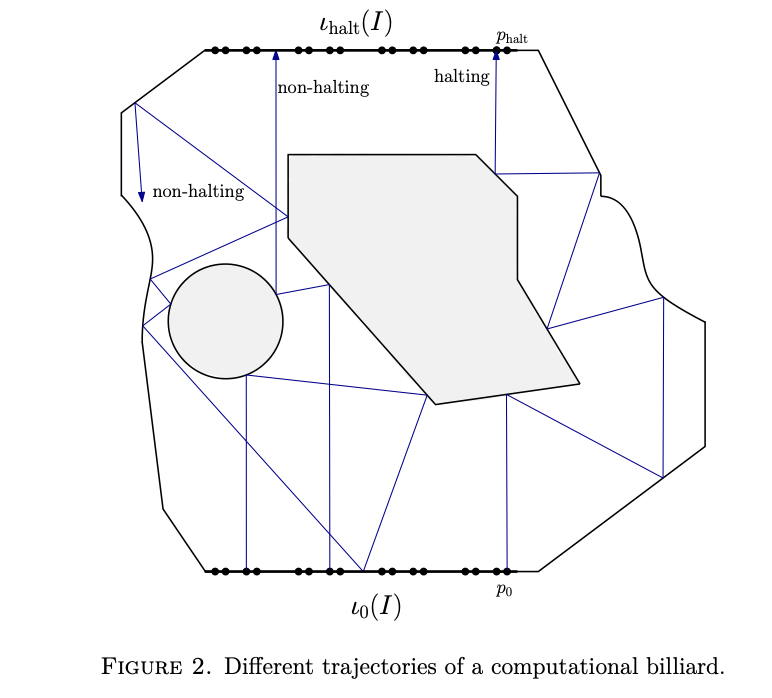
A program runs, and can either stop (and produce an output) or continue on forever in an infinite loop. Often, it's possible to determine whether a program will stop or go on forever. But Turing showed that it's not always possible: there is no prediction program that can always determine whether other programs will stop or not. Sometimes, the only way to find out what will happen to run the program. Such programs are called "undecidable."
Quanta ran a wonderful feature about undecidability as a kind of "next-level chaos" earlier this year. The gist is that, for any system that can behave like a computer, there are situations in which it'd be impossible to predict the future behavior even with perfect knowledge of the present. To find out what happens in the future, you have to just let things run and find out. And given Miranda and Ramos' finding, this kind of deep unpredictability extends even to the absurdly simple system of a hard ball rolling around in a static 2D environment.
 Charlie Wood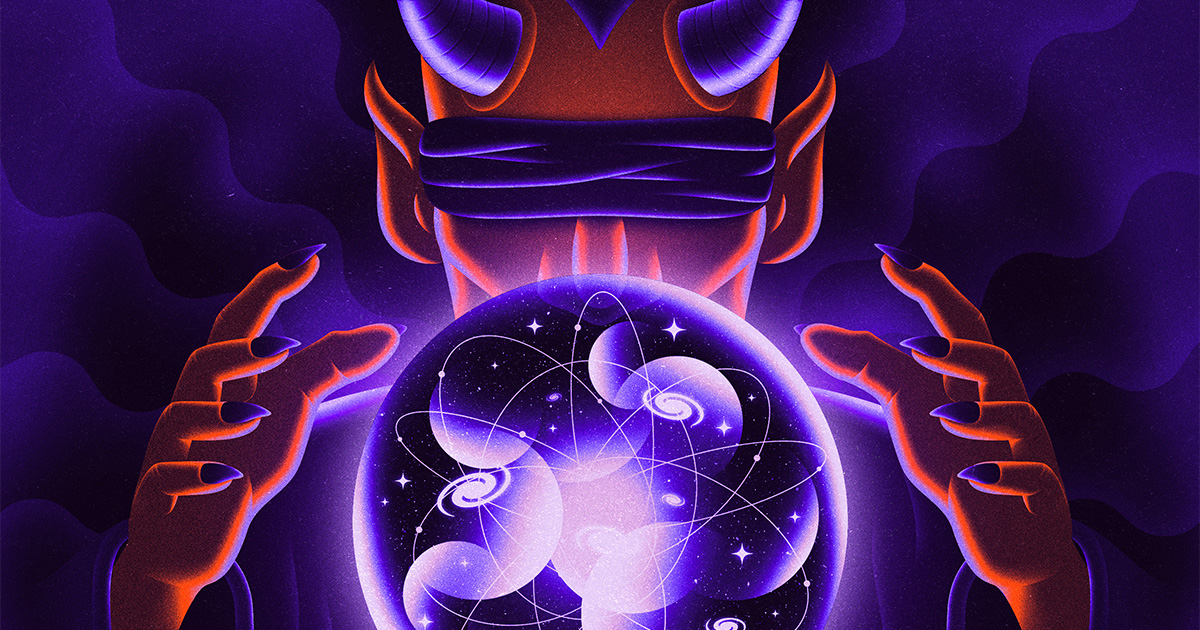
I spoke briefly with Miranda about this work and it sounds very exciting. She says she's been working on a more general mathematical bridge between dynamical systems and computation — what she calls Topological Kleene Field Theories — that she thinks could offer not just way to identify uncomputable physical systems, but also a whole new way to think about computation.
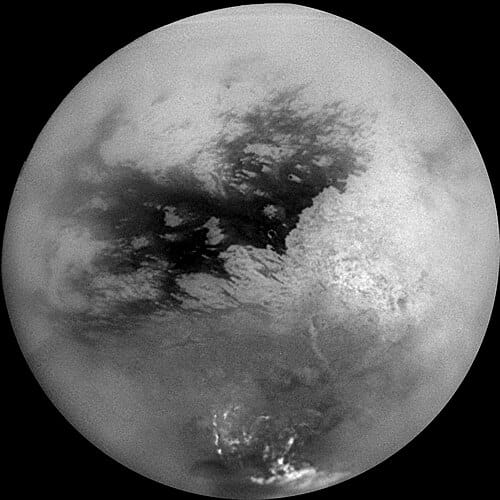
No subsurface ocean on Titan
Titan’s strong tidal dissipation precludes a subsurface ocean (Nature, December 17) by Flavio Petricca, Steven D. Vance, Marzia Parisi, Dustin Buccino, Gael Cascioli, Julie Castillo-Rogez, Brynna G. Downey, Francis Nimmo, Gabriel Tobie, Baptiste Journaux, Andrea Magnanini, Ula Jones, Mark Panning, Amirhossein Bagheri, Antonio Genova & Jonathan I. Lunine
Saturn's moon Titan is a prime target in the search for alien life. It's like a super cold, super weird mirror of Earth, complete with lakes and rivers and clouds — except temperatures are so low that the "water" is really liquid ethane and methane, and the "rock" is water ice. Any life on Titan's surface would be very, very alien. But scientists have long thought there could be oceans of liquid water far below the moon's frosty surface — perhaps even an ocean with a rocky (as opposed to icy) seafloor capable of sustaining the geochemical reactions that might have kick-started life on Earth.
Well, now new results suggest that there's probably no subsurface water ocean on Titan. A er-analysis of old Cassini data wiht improved techniques showed that the moon's response to Saturn's gravitational tugs is not consistent with a subsruface ocean. Instead, there might be a thick layer of icy slush pockmarked with little water-filled cavities. So it's not the end of the line for anyone hoping we'll find subsurface aliens on Titan one day. But it does change the picture.
How the romans built their urban jungles
An unfinished Pompeian construction site reveals ancient Roman building technology (Nature Communications, December 9 by Ellie Vaserman, James C. Weaver, Claire Hayhow, Kristin Bergmann, Celestino Grifa, Roberto Scalesse, Valeria Amoretti, Antonino Russo, Gennaro Iovino, Gabriel Zuchtriegel & Admir Masic
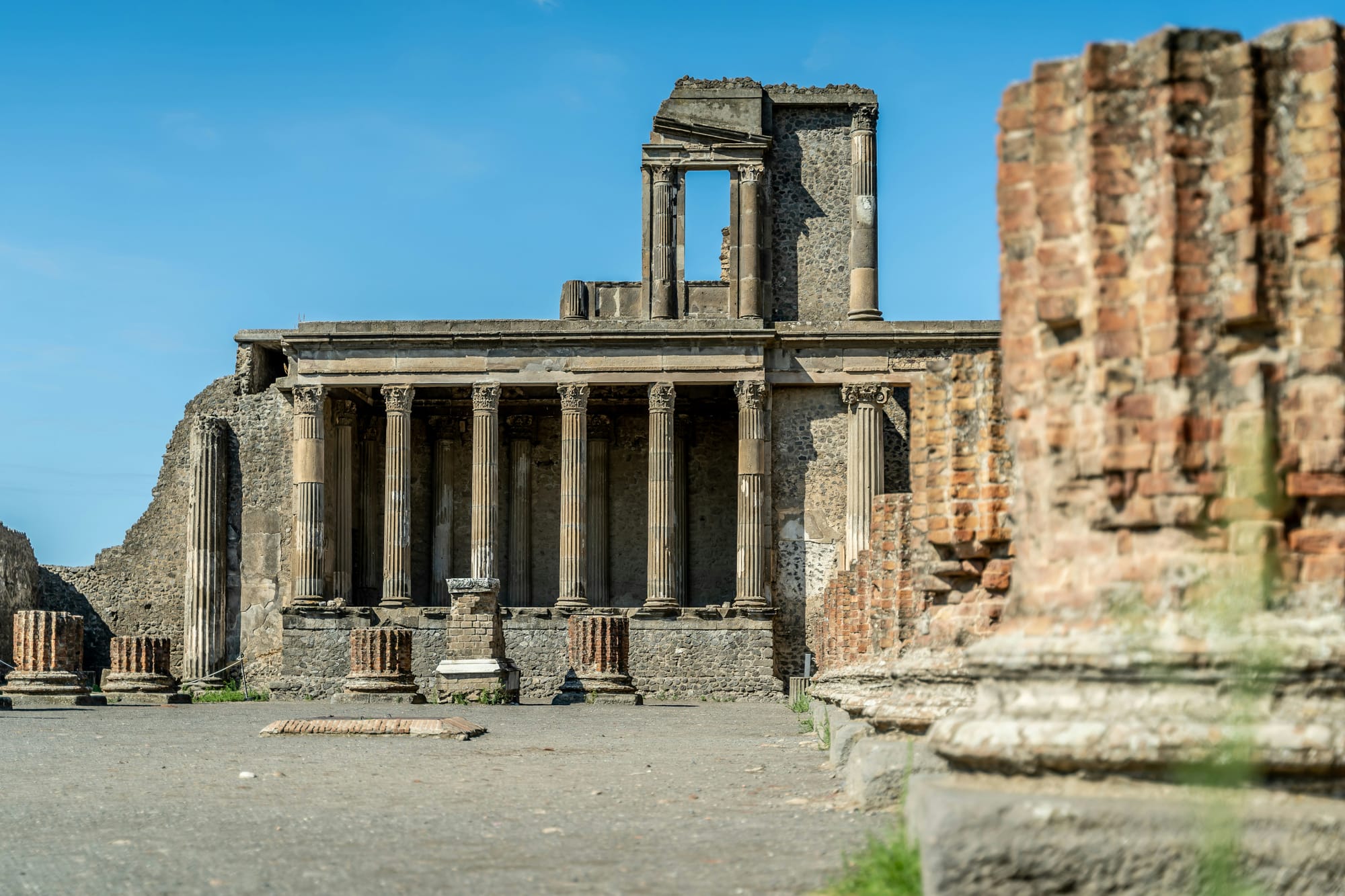
When Mount Vesuvius erupted in 79 CE, it buried the Roman town of Pompeii in ash that preserved a kind of grotesque snapshot of life at the time of the catastrophe. That snapshot famously included Pompeii's villas and art, but also more quotidian aspects of Roman life — including, now, a construction site.
The archaeological site revealed a surprise about how the Romans mixed concrete. One of the best sources on Roman building techniques, the 1st century treatise De architectura, held that builders would first mix quicklime (CaO) from limestone with water, and then combine that slurry (called slaked lime) to minerals containing silica and alumina (called pozolan). This creates cement.
However, builders at the Pompeii site did things differently. They used a pre-made mix of dry quicklime (CaO) and pozzolan (minerals containing silica and aluminum). When they added water to the mix, it initiated a heat-releasing chemical reaction. This is called hot mixing and it makes concrete very durable and capable of a degree of self-healing.
Can a planet be too hot for an atmosphere? Maybe not.
The JWST Rocky Worlds DDT Program Reveals GJ 3929b to Likely Be a Bare Rock (Astrophysical Journal Letters, December 12) by Qiao Xue, Michael Zhang, Brandon Park Coy, Madison Brady, Xuan Ji, Jacob L. Bean, Michael Radica, Andreas Seifahrt, Julian Stürmer, Rafael Luque, et al.
JWST NIRSpec finds no clear signs of an atmosphere on TOI-1685 b (arXiv preprint, December 17) by Chloe E. Fisher, Matthew J. Hooton, Amélie Gressier, Merlin Zgraggen, Meng Tian, Kevin Heng, Natalie H. Allen, Richard D. Chatterjee, Brett M. Morris, Nicholas W. Borsato, Néstor Espinoza, Daniel Kitzmann, Tobias G. Meier, Lars A. Buchhave, Adam J. Burgasser, Brice-Olivier Demory, Mark Fortune, H. Jens Hoeijmakers, Raphael Luque, Erik A. Meier Valdés, João M. Mendonça, Bibiana Prinoth, Alexander D. Rathcke, & Jake Taylor
A Thick Volatile Atmosphere on the Ultrahot Super-Earth TOI-561 b (arXiv preprint, Revised December 8) by Johanna K. Teske, Nicole L. Wallack, Anjali A. A. Piette, Lisa Dang, Tim Lichtenberg, Mykhaylo Plotnykov, Raymond T. Pierrehumbert, Emma Postolec, Samuel Boucher, Alex McGinty, Bo Peng, Diana Valencia & Mark Hammond
This trio of papers describes observations of three hot, rocky worlds — two are bare rocks, as expected. But one might have air. And that's super, super weird.
We still have no working theory that can reliably predict which rocky exoplanets will have atmospheres and which won't. The best working scheme is something called the cosmic shoreline, which sounds whimsical but is really just a line on a graph of a world's surface gravity versus the radiation it receives from its star — in our solar system, this line neatly separates the planets an moons with air from those without. We still don't know if this relationship holds in other systems (see my feature in Quanta if you're interested in the cosmic shoreline). But generally, the expectation is that hot, small exoplanets won't have atmospheres.
 Elise Cutts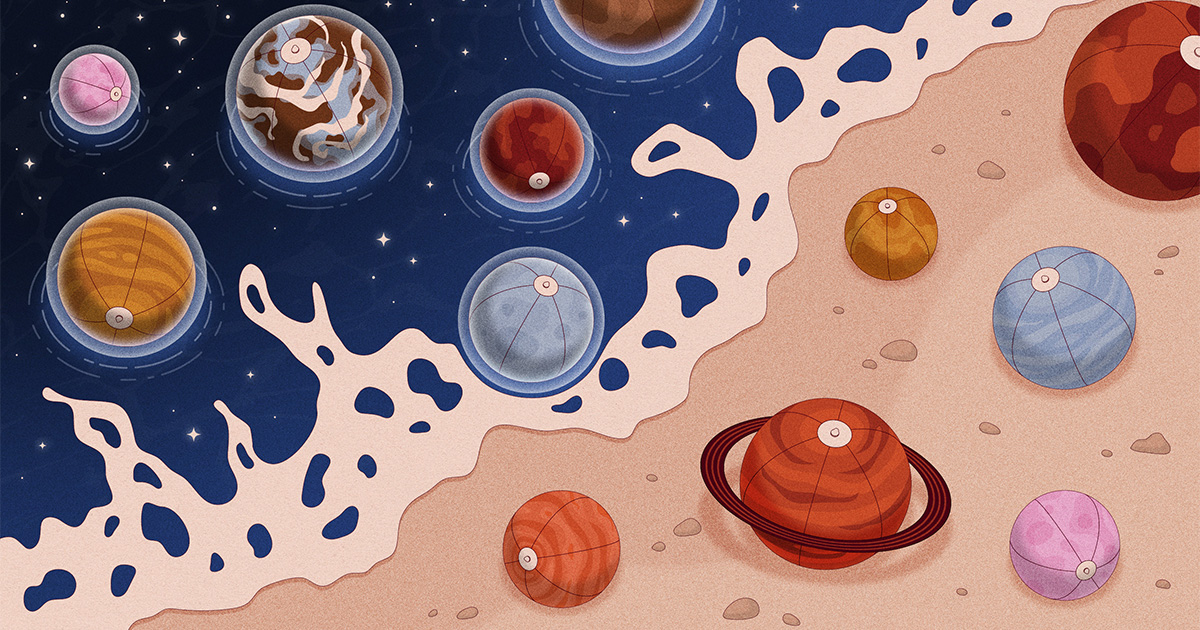
TOI-561 b is really hot. It is tidally locked, meaning one hemisphere always faces the sun and the other is always dark. And on its "day side," the temperature — if the had no atmosphere to spread the heat around — would be 3000 K. That's high enough to melt rock. But that's not what scientists saw when they used JWST to take this planet's temperature. They measured a cooler temperature, which only makes sense if there's air to redistribute heat to the "night side." (I wrote about this planet and its weird atmosphere for Scientific American a few months ago when the preprint first went up, but the study was updated in December and it looks like it is being officially published now.)
 Elise Cutts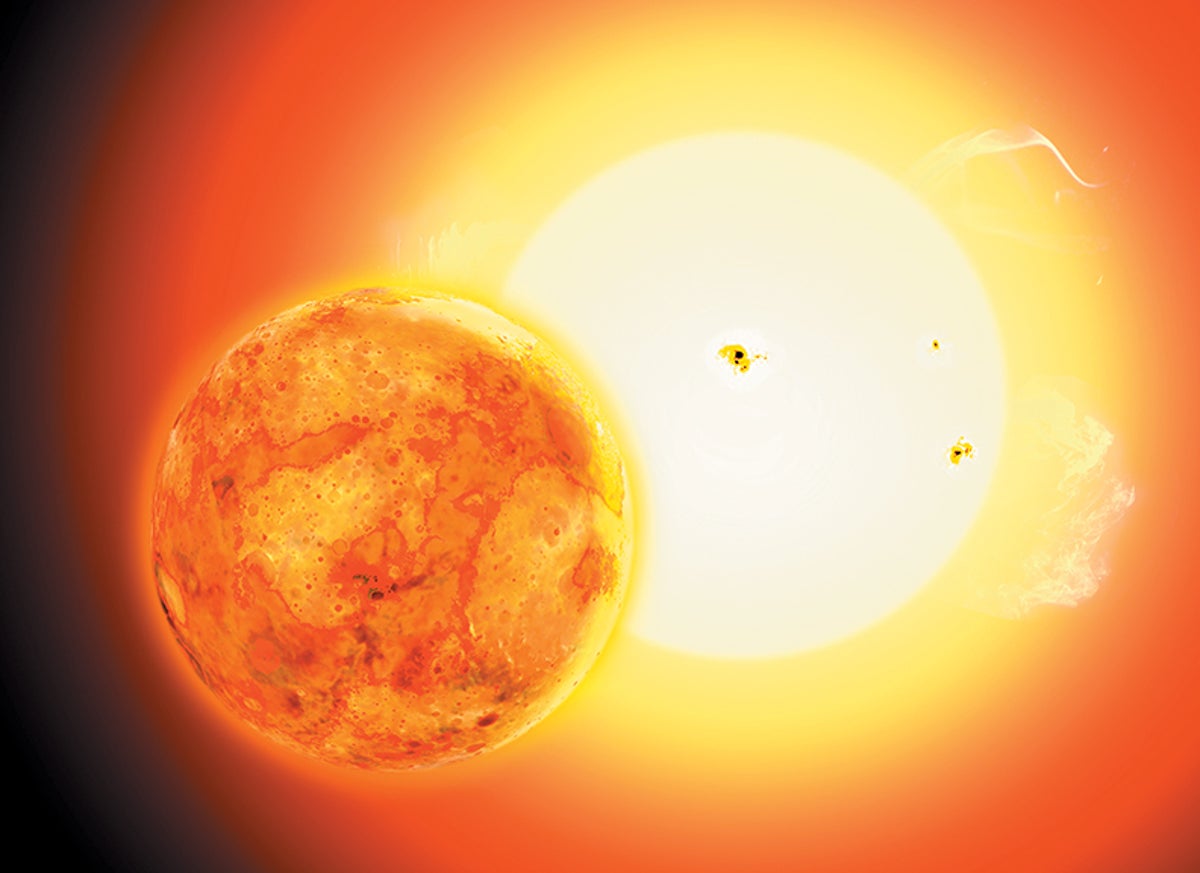
TOI-1685 b and GJ 3929b, on the other hand, don't have atmospheres despite being cooler than TOI-561 b. But both of them orbit volatile M dwarf stars, which have the nasty habit of spewing atmosphere-stripping radiation during their turbulent youths. We don't yet know enough about M dwarf systems (or atmospheres) to know if the absence of air on these hot worlds is an ill omen for air on cooler, potentially habitable planets also in orbit around M dwarfs. But there's an ongoing effort to use JWST to settle that question by looking at lots of rocky planets around M dwarfs — the GJ 3929 b study was a first release of results from that effort.
Geometry sets the embryo's clock
Geometry-driven asymmetric cell divisions pattern cell cycles and zygotic genome activation in the zebrafish embryo (Nature Physics, January 5) by Nikhil Mishra, Yuting Irene Li, Edouard Hannezo & Carl-Philipp Heisenberg
In embryos, geometry winds life's clock — that's the surprising finding of this recent study, which showed that the shape of zebrafish eggs plays a vital role in setting the tempo of the cellular clocks that coordinate development.
Eggs are just one cell, which divide over and over again to create countless copies and build up a multicellular organism. This biological construction project is kept on track by the cell cycle, which you can imagine as a kind of internal biological clock that tells cells when it is time to divide. As you might imagine, different parts of a developing embryo might need to grow faster or slower. So while the cell cycle starts out synched up, different parts of the embryo start to keep their own tempo later in development. And in the transition from synched to not-synched, small but consistent offsets of neighboring cells' clocks produce waves of cell division that ripple across embryos.
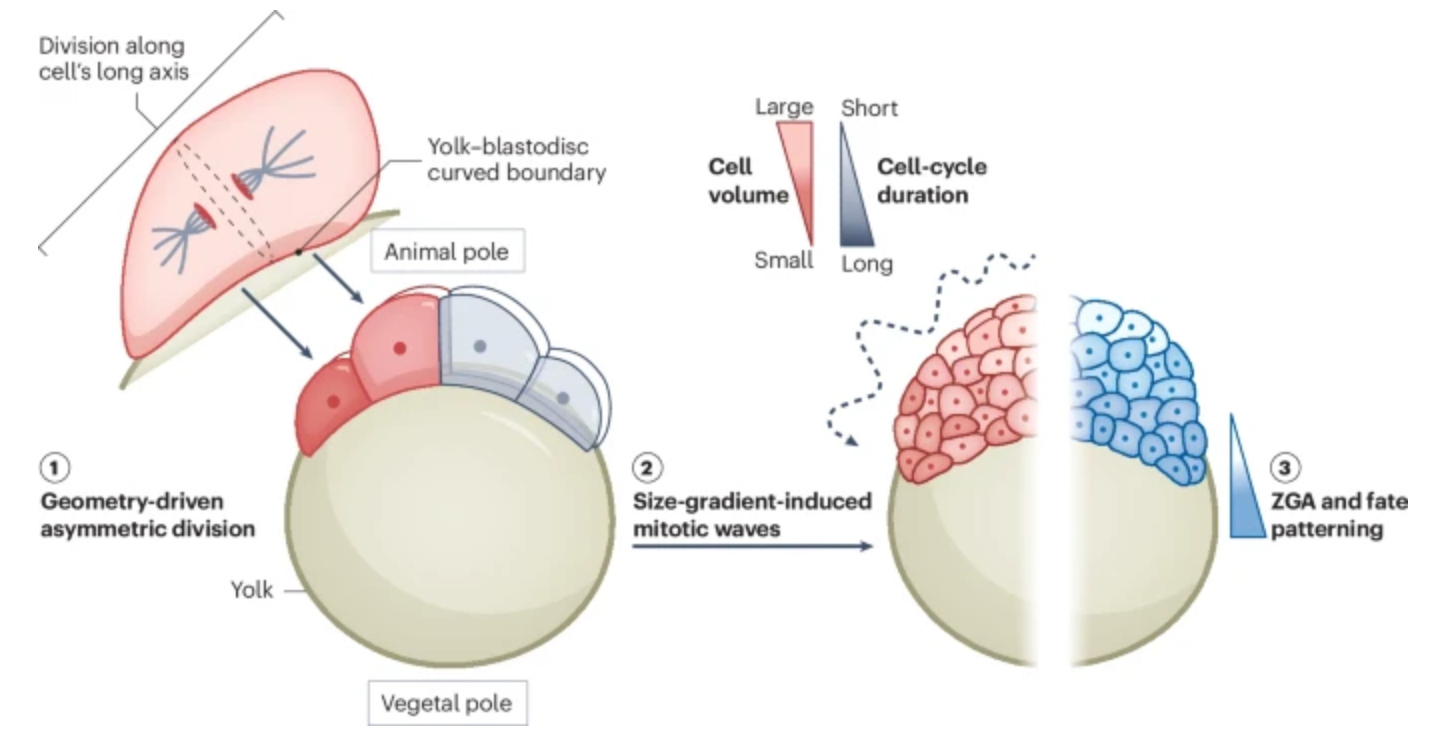
In this new study, the research team showed that a particular set of these cell division waves in zebrafish embryos are controlled by variations in the sizes of cells (bigger cells divide faster) — and that the distribution of cells of different sizes, and therefore speeds, was set by geometric constraints imposed by the specific curved shape of the embryo's yolk. The yolk's shape, far from being arbitrary, tuned the embryo's developmental clock.
Don't miss the next paper roundup! Subscribe to R2 to stay on top of the biggest ideas in astrobiology, origins of life, and complexity science.
The Rest
The Universe
- A possible challenge for cold and warm dark matter (Nature Astronomy, January 5) by Simona Vegetti, Simon D. M. White, John P. McKean, Devon M. Powell, Cristiana Spingola, Davide Massari, Giulia Despali & Christopher D. Fassnacht
- A second planetesimal collision in the Fomalhaut system (Science, December 18) by Paul Kalas, Jason J. Wang, Maxwell A. Millar-Blanchaer, Bin B. Ren, Mark C. Wyatt, Grant M. Kennedy, Maximilian Sommer, Thomas M. Esposito, Robert J. De Rosa & Michael Fitzgerald
Planets and Habitability
- High pressures depress the onset of intracellular vitrification (PLOS ONE, December 18) by Stewart Gault & Charles S. Cockell
- From Underground Oceans to Continents: A Glimpse into the Water Inventory on Rocky Planets Using Host Star Abundances (Astrophysical Journal, December 15) by Kiersten M. Boley, Wendy R. Panero, Francesca Miozzi, Ashika Capirala & Johanna K. Teske
- Multicolour Validation of Two Temperate Mini-Neptunes Around M-dwarf Habitable Zones (arXiv preprint, December 7) by Chengzi Jiang, Aleksandra Selezneva, Hannu Parviainen, Felipe Murgas, Enric Pallé, Gareb Fernández-Rodríguez, Samuel Geraldía-González, Jaume Orell-Miquel, Norio Narita, Akihiko Fukui, Jerome de Leon, Izuru Fukuda, Kai Ikuta, Kiyoe Kawauchi, Steve B. Howell, Colin Littlefield, Sarah J. Deveny, Joseph D. Twicken, Richard P. Schwarz & Avi Shporer
Astrobiology and SETI
- Self-assembled versus biological pattern formation in geology (arXiv preprint, January 1) by Julyan H. E. Cartwright, Charles S. Cockell, Julie G. Cosmidis, Silvia Holler, F. Javier Huertas, Sean F. Jordan, Pamela Knoll, Electra Kotopoulou, Corentin C. Loron, Sean McMahon, Anna Neubeck, Carlos Pimentel, C. Ignacio Sainz-Díaz & Piotr Szymczak
- The Eschatian Hypothesis (Research Notes of the AAS, December) by David Kipping
Origins and Artificial Life
- Influence of phosphate activation chemistry on the selection of the primordial genetic alphabet (bioRxiv preprint, December 25) by Filip Bošković, Jian Zhang, Alok Apan Swatiputra & Jack W. Szostak
- Selective funnelling and state-space expansion: a conceptual framework for novelty generation and origin events (Interface Focus, December 19) by Michael L. Wong, Heather Demarest, Stuart Bartlett, Carol E. Cleland, H. James Cleaves II, Anirudh Prabhu & Robert M. Hazen
- Hydrothermal origin of metabolic phosphorylation (bioRxiv preprint, December 19) by Manon L. Schlikker, Nadja K. Hoffmann & William F. Martin
- Interstep compatibility of a model for the prebiotic synthesis of RNA consistent with Hadean natural history (PNAS, December 15) by Yuta Hirakawa, Hyo-Joong Kim, Yoshihiro Furukawa, and Steven A. Benner
Earth
- An Archean atmosphere rich in sulfur biomolecules (PNAS, December 1) by Nathan W. Reed, Cade M. Christensen, Jason D. Surratt, Shawn Erin McGlynn, Boswell A. Wing, Cajetan Neubauer, Margaret A. Tolbert & Eleanor C. Browne
Human Body and Health
- Prevalence of Alzheimer’s disease pathology in the community (Nature, December 17) by Dag Aarsland, Anita Lenora Sunde, Diego A. Tovar-Rios, Antoine Leuzy, Tormod Fladby, Henrik Zetterberg, Kaj Blennow, Kübra Tan, Giovanni De Santis, Yara Yakoub, Burak Arslan, Hanna Huber, Ilaria Pola, Lana Grötschel, Guglielmo Di Molfetta, Håvard K. Skjellegrind, Geir Selbaek & Nicholas J. Ashton
Evolution and Ecosystems
- Neutral theory of cooperative dynamics (PNAS, December 15) by Jordi Piñero, Artemy Kolchinsky, Sidney Redner & Ricard Solé
- A place-based assessment of biodiversity intactness in sub-Saharan Africa (Nature, December 3) by Hayley S. Clements, Reinette Biggs, Alta De Vos, Emmanuel Do Linh San, Gareth P. Hempson, Birthe Linden, Bryan Maritz, Ara Monadjem, Chevonne Reynolds, Frances Siebert, Nicola Stevens, Matthew Child, Enrico Di Minin, Karen J. Esler, Maike Hamann, Ty Loft, Belinda Reyers, Odirilwe Selomane, Geethen Singh & Andrew L. Skowno
Information and Computation
- Granger Causality Maps for Langevin Systems (arXiv preprint, December 18) by Lionel Barnett, Benjamin Wahl, Nadine Spychala & Anil K. Seth
- An 11-qubit atom processor in silicon (Nature, December 17) by Hermann Edlbauer, Junliang Wang, A. M. Saffat-Ee Huq, Ian Thorvaldson, Michael T. Jones, Saiful Haque Misha, William J. Pappas, Christian M. Moehle, Yu-Ling Hsueh, Henric Bornemann, Samuel K. Gorman, Yousun Chung, Joris G. Keizer, Ludwik Kranz & Michelle Y. Simmons
Emergence
- Improved estimators of causal emergence for large systems (arXiv preprint, January 1) by Madalina I. Sas, Fernando E. Rosas, Hardik Rajpal, Daniel Bor, Henrik J. Jensen & Pedro A.M. Mediano
- Active Quantum Flocks (Physical Review Letters, December 10) by Reyhaneh Khasseh, Sascha Wald, Roderich Moessner, Christoph A. Weber & Markus Heyl
Society
- Higher-order interactions shape collective human behaviour (Nature Human Behavior, December 17) by Federico Battiston, Valerio Capraro, Fariba Karimi, Sune Lehmann, Andrea Bamberg Migliano, Onkar Sadekar, Angel Sánchez & Matjaž Perc
- Self-organized collapse of societies (Physical Review E, December 8) by Alexander Jochim & Stefan Bornholdt
Brain and Cognition
- A chromosome region linked to neurodevelopmental disorders influences locomotor behavior through sex-specific neural circuits (Nature Communications, January 3) by Jaekyoon Kim, Yann Vanrobaeys, Remya Rajan, M. Felicia Davatolhagh, Benjamin Kelvington, Snehajyoti Chatterjee, Sarah L. Ferri, Christopher Angelakos, Alea A. Mills, Marc V. Fuccillo, Kim T. Blackwell, Thomas Nickl-Jockschat & Ted Abel
- Sleep-dependent infraslow rhythms are evolutionarily conserved across reptiles and mammals (Nature Neuroscience, December 29) by Antoine Bergel, Julien M. Schmidt, Baptiste Barrillot, Sébastien Arthaud, Laetitia Averty, Mark S. Blumberg, Camille Carachet, Angeline Clair, Irina Filchenko, Chloé Froidevaux, Anthony Herrel, Bertrand Massot, Niels C. Rattenborg, Markus H. Schmidt, Mickael Tanter, Gianina Ungurean & Paul-Antoine Libourel
- A hippocampal ‘sharp-wave sleep’ state that is dissociable from cortical sleep (Nature Neuroscience, December 11) by Graham Findlay, Matias Lorenzo Cavelli, Tom Bugnon, William Marshall, Giulio Tononi & Chiara Cirelli
- Spatial and morphological organization of mitochondria in neurons across a connectome (Science, December 11) by Garrett Sager, Paul Pfeiffer, Heng Wu, Fabian Pallasdies, Robert Gowers, Snusha Ravikumar, Elizabeth Wu, Daniel Colón-Ramos, Susanne Schreiber & Damon A. Clark
Artificial Intelligence
- A Disproof of Large Language Model Consciousness: The Necessity of Continual Learning for Consciousness (arXiv preprint, December 14) by Erik Hoel
Just for Fun
- Yes, your accent is contagious: Exposure to an accent transfers to speech production in a single shot (Cognition, December 25) by Timothy K. Murphy, Lori L. Holt & Nazbanou Nozari
- Are punctuation marks words? Maybe: Average shortest-path length in word-adjacency networks: Chinese versus English (Physical Review E, December 30) by Jakub Dec, Michał Dolina, Stanisław Drożdż, Jarosław Kwapień, Jin Liu & Tomasz Stanisz
Thanks for reading! It's thanks to patrons like you that I can continue writing R2. You can help even more by sharing this post with a friend, leaving a comment, or dropping a tip in my tip jar.