Are scientists to blame for sensationalist science news?
Scientists have more control than they might think — but it's still not a lot.


Yesterday, biologist Carl Bergstrom posted a Bluesky thread criticizing a press release from the University of California, Berkeley about a study on skill atrophy caused by AI. The headline absolutely delighted whatever part of my brain handles confirmation bias: "Using AI for just 10 minutes erodes your ability to persist at hard things." Yes! Yes! This is exactly what I want to believe!
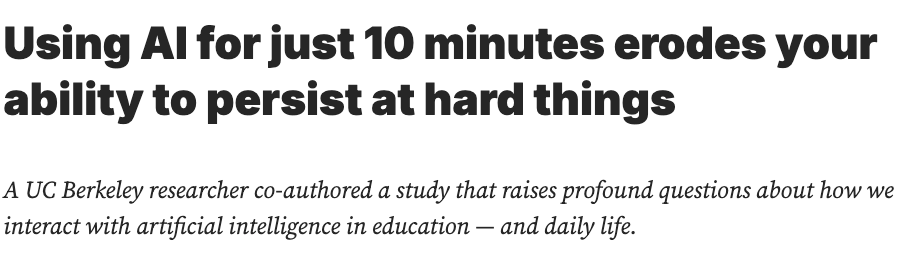
Bergstrom's critique of this particular press release echoes a common science news gripe: the study's actual finding is a lot less dramatic than the headline. It sounds like this "landmark study" (to quote the press release) proved that just 10 minutes of using an LLM inflicts lasting damage on your ability to keep going in the face of hardship. But what the paper actually found is, if you have people solve fraction problems and reading comprehension questions with AI for 10 minutes and take AI away and see how they perform afterwards with no consequences for wrong answers, they give up faster than people who were never given AI. Bergstrom compared this to studying what'd happen if you asked people to dig holes, gave one group shovels and another trowels, and took the shovels away halfway through.
The point of this post isn't to get into the details of this particular paper or Bergstrom's critique of it. What's more interesting than any of that, in my view, is a question that emerged out of one of the co-author's responses.
Rachit Dubey, one of the co-authors of the AI skill erosion study, posted that "the press implying 10 minutes of AI use will erode thinking is really misrepresenting our study and we never advocate for that language. It is not the author's fault that the press is doing weird writeups about our study which we don't endorse!" Bergstrom replied to "vehemently disagree" with that post: "It is ABSOLUTELY the author's fault if a university press office misrepresents their work ... While eg the NY Times may not give you the opportunity to vet, let alone rewrite, portions of a story about your work, university press offices serve a different function and therefore they do. It's your obligation to avail yourself of that opportunity just as it is to be honest in your prose."
How much control over — and responsibility for — science news coverage do scientists actually have?
Hey there! You're seeing this because you're not (yet) a subscriber. This is the Monday Edition: an essay or news brief followed by a round-up of news and new studies about the systems that shape science and its broader impacts. (Read more about R2's core themes here). Sign up for free to read the entire post. As one subscriber told me recently "this newsletter is the only reason I know anything about what's going on in science!"
Yes, scientists are partially responsible for bad press releases
Let's get one thing clear right away: university press releases are not journalism, even though they're shaped like news stories. They are ads written by institutions to catch the attention of the media. Bergstrom is correct that scientists have considerable control over press releases, in a way that they absolutely do not have control over news media (or podcasters, or bloggers, or YouTubers, or or or).
This is not a paywall!
Subscribe for free to keep reading.