A scammer impersonated a science journalist. It worked.
AI fraud is going to make it harder for new voices to break into science journalism


A fraudster impersonated a science journalist and successfully sold a story to the news section of Science. It was published, and the scammer got paid.
Um, what? Come again?
Last week, Caroline Williams — a UK-based science journalist and author — made several LinkedIn posts recounting a disturbing scam in which someone pretended to be her, pitched several editors at Nature and Science stories related to her actual beat, and managed to sell one of those stories to Science. Never have I seen the science journalism gossip machine churn so intensely! Is it AI? It has to be AI, right?
This scam is unfortunately one of many. And while the potential reputational harm to individual journalists is very concerning, there are implications that the entire field will have to deal with. Fraud erodes trust in ways that could reshape science journalism in ways that threaten diversity, openness, and fairness. I originally wanted to try to report a story on this. But I'm flying to the US today and simply did not have the time for that. What I did have time to do was trawl through the publicly available information and write up some thoughts on why this matters. Behold: the synthesis of 100 social media posts you do not have to read yourself.
According to her posts, Williams only found out about the scam after Nature editor Brendan Maher reached out to tell her that someone was impersonating her. Based on screenshots posted by Williams, it looks like the scammer emailed a Nature editor on August 24 to pitch a story on interoception and mental illness. These are topics Williams would feasibly write about. The pitch reads as plausible, but rambly. It's vague and, weirdly, doesn't link to any of the studies it mentions or name any specific researchers. Williams said that it took "two experienced editors," including one that knew her personally, several rounds of back-and-forth emailing with the scammer to realize something was fishy about the emails. Maher alerted Williams to the scam, and she emailed the scammer to threaten legal action.
But pitching Nature wasn't all Fake-Williams was up to. On June 19, Science published a story by "Caroline Williams" that Williams didn't write.
Williams found out about this, and on September 16, the scammer's story was removed and replaced with a statement explaining that the author had been impersonating a science journalist. Williams shared on LinkedIn that Fake-Williams was "emailing scientists I have known for years, posing as me to ask for quotes. Quite convincingly, apparently - even though the scientist in question was confused by the tone of 'my' email." Two of the quotes in the story were also found to have been recycled from stories published by other writers. According to Williams' posts, the scammer was paid by Science. This means that it might be possible to learn more about who they are. But as of this writing, we don't know who the scammer is. Williams claimed to have reported the scammer to the UK police for identity theft, and that they opened and closed the case very quickly.
The original Science story was removed and can't be read via official channels, but a Reddit user appears to have posted the whole original text. A story published on Earth.com under the byline Andrei Ionescu after the Science scam story went live is almost a word-for-word copy. Williams said she originally thought the copied story was a syndication deal — though that'd be weird, given the byline. The Earth.com text reads like an LLM-remix of the text posted to Reddit.
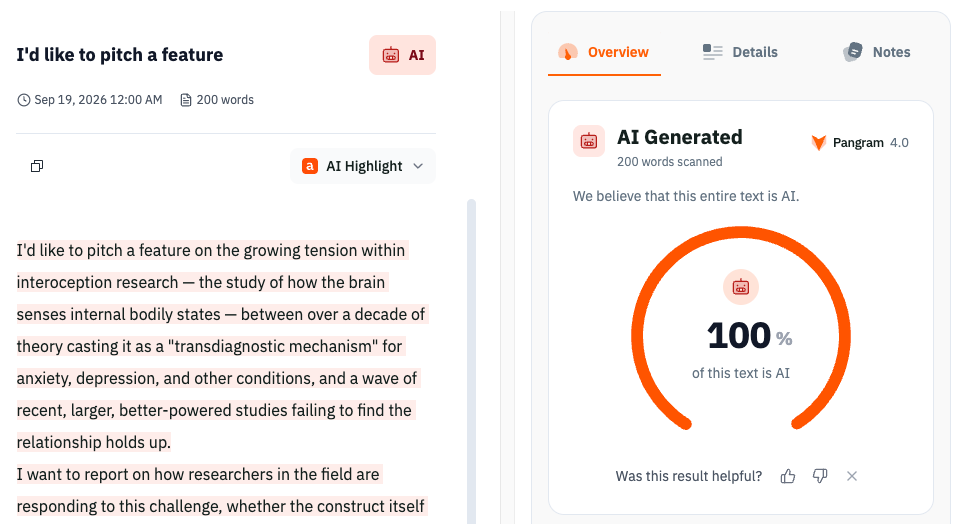
There's no conclusive evidence that the scammer was using AI. But I ran the publicly-posted email from Fake-Williams through Pangram, an AI text detector, and it came back 100% AI-generated (click for receipt). Pangram estimated the Earth.com story is 71% AI.
Why would scammers impersonate freelance journalists?
After Williams shared what had happened, many were left scratching their heads: Why would anyone do this? It couldn't possibly be the pay, right? Freelance journalists are paid so little!
It's true that freelance journalism isn't exactly lucrative. On the science beat, the minimum rate expected by freelance journalists these days is $1/word — a standard rate that hasn't changed in decades, despite inflation. The most I've ever been paid for a story is $2/word for features in Quanta and Scientific American. At Science, where this scammer sold their story, the freelance rate is around $1/word but goes higher for experienced writers. The scammer had to find, pitch, write, and edit their story, and handle many rounds of emails with editors over weeks. That seems like both a lot of effort and a lot of risk of being discovered for a reward of something like $800 (the scam-story was probably no more than 800 words long). But think like a fraudster, and it starts to make sense.
This is not a paywall!
Subscribe for free to keep reading.