1000s German academics have to teach — even if they're never paid for it
In Germany and Austria there's a degree higher than a PhD traditionally required for professorships, and it's kind of a terrible deal.


Unless you're rich, well-connected, a prodigy supergenius, or all three (though the first two alone will do just fine), academic research is a Kafkaesque nightmare of a career path. But it's especially Kafkaesque in the places where Kafka is widely enjoyed in the original German. The germanosphere's academic system is uniquely stiff, hierarchical, and punishing for early-career researchers. In a previous post, I wrote about how there's a missing rung on the academic career ladder in Germany and Austria: it's an enormous leap from PhD to professor since there has historically not been a position equivalent to assistant professor (US) or lecturer (UK). If you thought that was bad, you just wait! There's more! Because where there should be an assistant professor-level career stage, there's a trap that looks like a job, but is actually required unpaid work.
Meet the Privatdozent*: a German academic position so awful that a 19th century satirical artist depicted it as a mummy wrapped up in hopes and dreams.
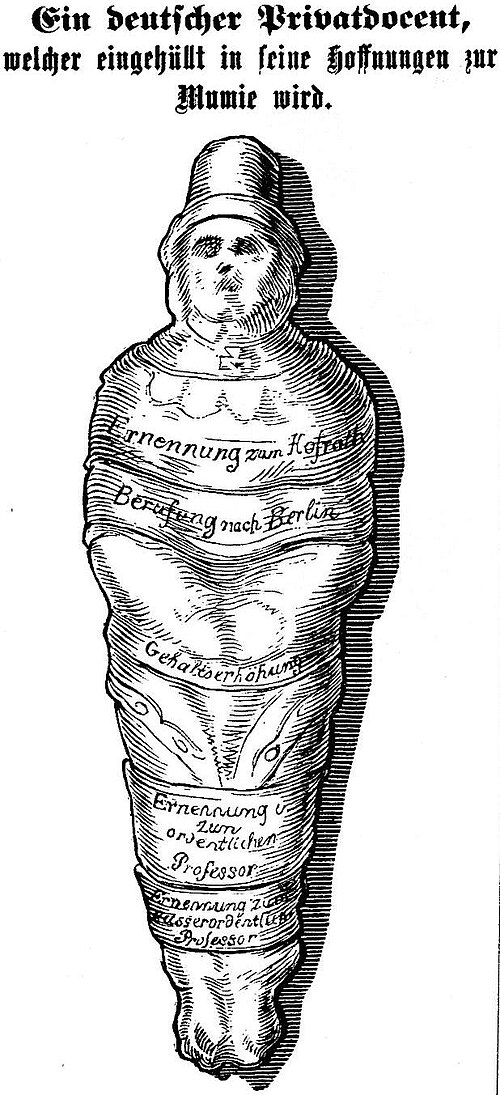
Privatdozenten occupy a middle-middle ground between postdoc and professor. In the German-speaking world (and in some other countries), a PhD is not the highest degree. Germanosphere postdocs traditionally do something like a second PhD thesis, called a habilitation, to qualify for a "calling" (Berufung) as a professor. It was only about 20 years ago that the German and Austrian academic systems modernized to create alternate qualifications for professorships. In Germany, these include leading a research group e.g. at a Max Planck Institute or receiving a rare junior professor position — a new academic grade introduced in the early 2000s that still accounts for only a tiny fraction of professorships in Germany. Habilitation is still the normal route and in some fields is basically required. In addition to qualifying you for professorships, a habilitation grants the ability to teach independently (i.e., not under the supervision of a more senior academic) and advise graduate students at a university. So long as you can teach independently at a university, you hold the title of Privatdozent — and it is a title, not a job, even though it is tied to your ability to teach at a specific university.
This is not a paywall!
Subscribe for free to keep reading.