What determines how science is done — and how it matters?
The newsletter is back with a new focus on the systems, instincts, and incentives that shape what's discovered, what's believed, and what happens when science hits the real world

After several months on pause, the newsletter is back! Reviewer, too is relaunching next week with a whole new format and focus. You can read all about the newsletter's new direction over at the freshly updated About page.
To everyone who's still here: thank you for your patience!
Here's what you need to know about what's next.
 Elise Cutts
What's changing
Reviewer, too used to be kind of... chaotic. I'd write about science I thought was interesting with a fuzzy focus on complexity science. Editorially, I was aiming for something vaguely like Sean Carroll's Mindscape podcast, which is less about going deep on one specific theme and more about exploring big ideas. That didn't work well for me or for readers, so it's over.
The new newsletter is focused on a new theme: the systems, instincts, and incentives that shape what's discovered, what's believed, and what happens when science hits the real world. I've broken the scope into five core themes: metascience and innovation, science under threat, truth and the infosphere, AI in science, and bias, attention and vibes. You can read more on the About page.
I aim to do four things for subscribers: keep you informed, spark conversations, make things make sense, and report exclusives. With those goals in mind, I'm also changing the format of the newsletter. Instead of posting every Thursday, I'm splitting the newsletter into a newsy, quick Monday edition that posts each week and a meatier Thursday edition featuring deep dives, reported essays, Q&As, book reviews, and more that posts twice monthly.
A major goal of this relaunch is to post more original reporting. I also plan to do more data visualization and start dipping my toes into data journalism — so expect more charts going forward.
I want to give this a genuine go, so I'm taking a financial risk winding down my magazine reporting over the next few months (there are still some lingering projects) to have more time to do genuine journalism for the newsletter. So paid subscriptions make a big difference right now. You can support my work for just €0.50 per post and get access to the patrons-only post each month. I'm working on better perks for paid supporters like audio editions, a community Discord, and a quarterly controversial hot take post.
Finally, I've written an extensive AI policy for the relaunch so you can see how I use AI in my work. TLDR: I don't use it to write or produce art, but I do use it for research, transcription, and other support tasks.
Relaunch schedule
To avoid trying to start too much at once, I'm giving myself a bit of time to work up to the full posting schedule:
Starting next week, you'll get the weekly Monday newsletter. These are intended as quick reads: a short (~300-word) essay, analysis, or breakdown of a data visualization followed by Citation Needed, a newsy roundup section of links with a bit of commentary.
Starting next month, you'll get the twice-monthly Thursday editions. This is the main newsletter: meaty original reporting, essays, Q&As, and more.
Tips, suggestions, and feedback
Get in touch by emailing elise@reviewertoo.com. I respond to everything that isn't obvious spam or AI garbage.
Constructive feedback and tips are greatly appreciated. I'm always looking for Q&A interview candidates — researchers, activists, journalists, communicators, educators, policy folks, and anyone else who has something important or interesting to say about science in society. If that's you or someone you know, reach out to suggest them.
Why did this happen?
For those not in the know, I recently had a bit of a crisis of purpose regarding my work as a science journalist — and, less dramatically, about this newsletter — several months ago. This began back in February, when I wrote about how the "general audience" of pop science is mostly an audience of educated, wealthy nerds. That sent me down a rabbit hole of looking into things like literacy stats and magazine vs TikTok audience sizes and — never a good idea — thinking about what it was, exactly, I was doing with my life. Writing physics entertainment for retired engineers is not really how I saw myself and my work. But if I was being honest, that's mostly what I was doing.
Then I started a journalism residency (a kind of sabbatical) at the Complexity Science Hub through the European Research Council's FRONTIERS program. The mandatory in-person training included a session in which the trainer basically said flat-out that AI is great at synthesizing research and will replace journalists except for stories requiring in-person reportage. When I asked what the point of my job is, then, the people running this program — a program that supposedly deemed my explanatory reporting important enough to fund — told me that I can find a new purpose as a source of good, journalistic AI training data.
That, uh, made me sad.
For a few months, I was a mopey blob. The moping was clearly a symptom of uncertainty about my career in the face of AI, but also of a deeper dissonance between what I wanted to do and what I was actually doing. And what did I want to do, anyway? Why did I care about science, again? What, exactly, was I hoping to accomplish by spending my life telling people about it?
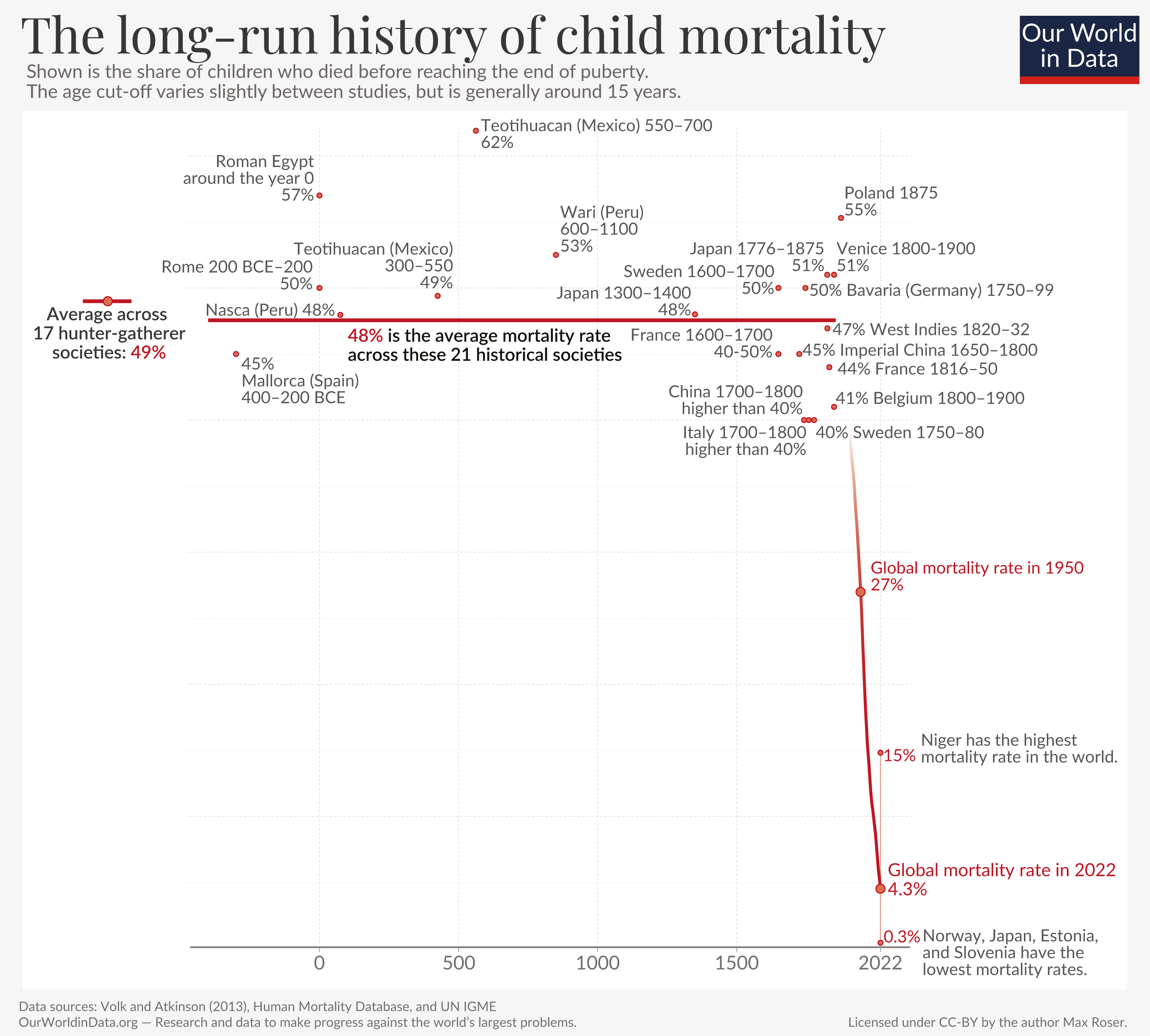
Thankfully, a couple of inspiring talks on metascience and innovation at the Complexity Science Hub — and a graph of childhood mortality rates from Our World in Data — helped me find my footing: I care about science because it is our most powerful way of understanding the world, and understanding the world is how humans make life better for each other. Science is why most children now get to grow up instead of half of them dying before puberty. Science is how we free ourselves from vicious cycles, no-win scenarios, and zero-sum games.
I realize it's maybe cliché or naive or somehow even right-wing-coded to believe in progress these days. But I believe. I think progress is real and worth striving for, and that if we want a better, fairer future we will have to innovate our way into it. Science matters — and that means the forces at work in how research is done, shared, spread, and acted upon matter too. So that's what I'm going to focus on here at Reviewer, too from here on out. I want to do more than write science entertainment. This newsletter is my attempt to do that.
I hope it helps.