Are the Stardew Valley wiki authors scientists?
Science is the generational project of finding out true things about the real world — and that project needs catalogers

There are people out there who — for reasons I'll never understand — have the unusual combination of patience and truly obsessive energy required to turn the wild wonders of the universe into reams of systematically annotated data.
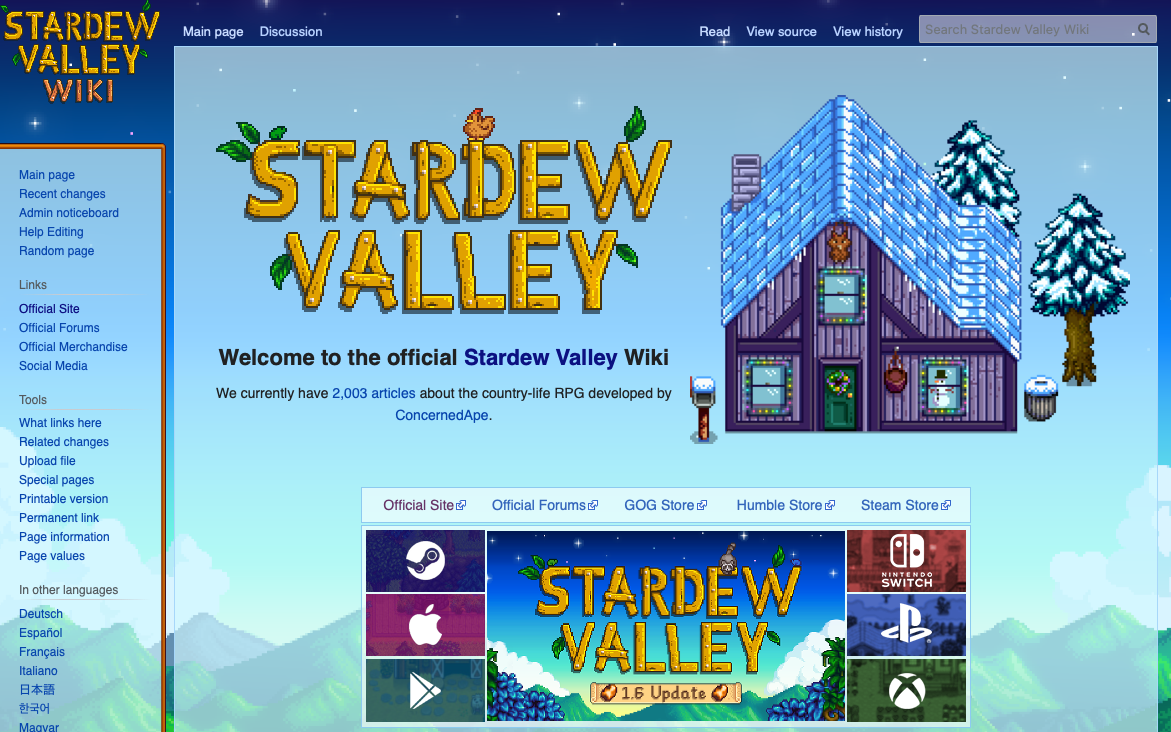
They are the catalogers. You probably know one or two. The catalogers are the obsessive gamers who document every little detail of the farm simulation video game Stardew Valley, down to the last hidden secret. They are the rock collectors who buy bigger houses so they can convert a whole floor into a personal museum. They are your hyper-fans, your super-nerds, your mega-geeks. They are the people who somehow maintained the kind of sharp, ceaseless focus necessary to devote entire lifetimes to recording the precise positions of heavenly objects in the millennia before robotic astronomy.
To me, it is obvious that science needs catalogers — and that obsessively documenting video game lore or butterflies is, in a way, scientific. Even if done without scientific intent, detailed and systematic datasets are what make a lot of science possible.
But cataloging is not the kind of research that tends to get grant money. In fact, granting bodies like the European Research Council have a whole vocabulary built up to disqualify research that sounds too much like cataloging. Any scientist who's ever applied for a grant will know that suggesting a "fishing expedition" — let's just go see what we find and record it — is a good way to get a grant rejected.[1]
The kind of research that does get funded is what the ERC calls "frontier science." This is a Europe-specific word for an idea you'll find everywhere: theory-driven science that tests a hypothesis that is, by some measure, cool, interesting, or useful. Scientists should have a clear idea about the theory they want to test or the knowledge they want to gain, and design an experiment or research program to specifically address that knowledge gap — and the more widely useful the gained knowledge, the better. Finding out all the proteins in Gila Monster spit is cataloging. But finding one that inspires GLP-1 drugs is "frontier."[2]
It's not just grant agencies. Cataloging is also not the kind of research that scientists themselves seem to value much — it is seen as lesser science. Lab techs who collect data often don't end up on papers that analyze it. And it can go even further than that. I'm writing this because yesterday at lunch, I mentioned off-hand that I think science benefits from having both people who fixate more on theory and people I called "catalogers" who are happy to spend their lives counting bugs with exacting detail. A a physicist here at the Complexity Science Hub responded that he not only doesn't consider cataloging to be science — but that he thinks science does not need catalogers at all.
Really?
Sexy science is big if true
I will admit, I am not personally very interested in cataloging. It just isn't very sexy — or maybe I simply lack the patience to be interested in learning every last detail about literally anything.
Even if that's true (it is), I am not the only one who feels this way. I would have a hard time selling a story to a magazine editor about some new exhaustive list of bugs living in some forest in Austria. But an easy time selling a story about the discovery of a new bug whose poop cures sickle cell anemia — or about how cataloging bugs in some forest in Austria for decades somehow led to the discovery of a new physical law that perfectly describes swarm behavior in fish, robots, and human crowds.
Basically, cataloging is not sexy. Sexy science is "big if true." In jargonese, it is generalizable. It goes beyond individual specifics to reveal some greater truth that's useful beyond the domain it was originally discovered in — whether that by enabling a helpful new technology or helping explain other phenomena in the natural world.
This is why physicists dream of discovering unifying theories that can explain multiple forces of nature at once. They've done it already for three of the four fundamental forces, but gravity stubbornly refuses to be unified with the other three. The person who manages to squish all four forces together will get a Nobel Prize.
Cataloging is not like that. By definition, it is concerned with individual specifics. And in its pure form, it doesn't care about theory at all — it's not out to prove anything, just to observe and record.

Look. You and I both know that if I were a barista, you'd 100% be leaving a tip right now. The social pressure to drop a coin in that jar would just be overwhelming. But you're presumably reading this thing alone on a universe-rectangle, so I can't rely on my mere presence to remind you to be nice.
If you made it this far I assume you're enjoying the article. So maybe drop a coin in my digital tip jar. It's just €2 per month (€0.25 per post!) — a cheap and fully automated weekly warm fuzzy feeling for the digital age.
Does science need catalogers?
To me, it is obvious that science absolutely needs people who do this kind of thing. But my (admittedly trollish) physicist lunch buddy at the Complexity Science Hub disagrees. Catalogers, he says, are not scientists — and not only that, science does not need catalogers at all.
His argument went something like this:
Scientist do science, and science means building and testing theories about the world. Cataloging stuff does not test a theory about the world. And even further, cataloging is not useful to scientists unless it is done with a specific theory in mind. Data is useful when it is collected to test a hypothesis, and never otherwise. You are only a scientist if you are in the theory-building and theory-testing business. And science is only really science when it is seeking generalizable theories (the true spirit of a physicist right there).
To prove his point, he used an example: If I were to just go out and collect all the yellow things I see and make a big list of them, is that useful to science?
I said yes, I think that is useful to science — so long as the collecting and annotating is done in a way that's systematic enough to pick out something real about the world. In this case, the catalog reveals something about how people perceive color. One can easily imagine a color researcher stumbling upon this crazy detailed catalog of all the yellow things in Vienna and using it to learn something about the edges of yellow perception — esp. if more than one obsessive fan of yellow had done something similar in another place, another culture, etc. and the datasets could be compared. There's something systematic about picking out just the yellow things, and that systematic sampling is based in — and therefore reveals something about — the physical world.
Our physicist friend was not really convinced. So I responded with my own example: there are plenty of researchers, including several here at the Complexity Science Hub whose entire job is to carefully annotate data so that the beautiful theories drawn up by their colleagues can actually be tested. Are those people scientists?
I thought he'd be forced to admit that yes, those people are indeed scientists. But he laughed and evaded in a way that made it pretty clear that he'd put them in the same non-scientist category as the yellow collector. Catalogers, to him, are not scientists unless take what they learn from annotating the data and get it incorporated into theories.
This is, to me, just obviously wrong and puts one particular kind of thinking on a pedestal to the strange and unhelpful exclusion of other parts of the scientific project. Without people who actually go through the effort of carefully turning the world into numbers, there can be no science. And just going out and cataloging with no intention to theorize is, I think, more likely to end up resulting in useful knowledge than just sitting around and theorizing with no intention to catalog. That is how humans figured out most things before a few weird groups of us fact, I think that theorists are more in danger of ending up "not doing science" than catalogers.
What is science, and who is a scientist?
Whether or not you consider cataloging to be science will, ultimately, come down to what you think science is. And this conversation kind of pushed me into actually crystallizing my own personal definition:
To me, science is the generational project of finding out true things about the real (physical) world.
I do not consider theologies to be science. They are models of the world, I'm even comfortable calling them theories — they do make predictions about the real world. But they are less concerned with how the world is than how it should be or might be, and aren't open to being proven wrong by observation. They don't answer to reality the way a person sorting butterflies by size and color or ordering rocks by hardness is. And science must always be ready to answer to reality.
That's easy enough to swallow for the natural world, I think. But what about the Pokemon geeks? What about people who document the life of Taylor Swift in excruciating detail? What about the Marvel nerds who have probably produced more documentation of comic books than there are comic books? Well, I'm a physicalist. So all there is, to me, is the physical world. Just because a video game or comic book was made by a human does not mean it is somehow not manifest in physical reality. You can make provably false statements about them in a way you can't about gods or magic.[3] Video game wiki contributors are held to account by reality, so yeah: their work could fairly be called scientific.
My definition of science is admittedly fuzzy, and I do invite you to challenge it. But to me, right now, it hits the sweet spot because it is both inclusive and exclusive. It acknowledges cataloging — making detailed, systematic, and/or quantitative observations of the world — as science, without also including nonscientific "ways of knowing" like spirituality and myths that aren't beholden to reality.
I also like this way of thinking because it is less interested in whether an individual person is a scientist than if they do science. "Scientist" is a modern professional term and scientists are a particular modern professional community with particular institutions. But you don't have to be a scientist to do science. Just like you don't have to be a runner to run.
And maybe a bit ironically, this definition is more critical of theorizing than it is of cataloging. The theorist who gets so lost in the clouds that they stop caring about whether their beautiful models actually capture anything real is further from science than the obsessive hobbyist who takes enormous care to document every mushroom growing in one particular alpine forest — or in Stardew Valley.
Footnotes
[1]: That is, of course, unless you're fishing uncharted waters for the first time using a new and interesting technique nobody yet understands. Then you can argue that you're pushing some frontier. But the trick doesn't work forever, as my former field, geobiology, found out with environmental DNA sequencing. It used to be that any big new environmental DNA dataset on any environment could probably land in a good journal. But now, just going out and sequencing deep-sea mud won't cut it.
[2]: If you have the uneasy feeling that some of the reasoning about what constitutes breakthrough or frontier science is retroactive — hold onto that feeling. Chew on it. I plan on coming back to this problem in a future post.
[3]: You could of course make false statements about what people belive about gods or magic — you can certainly document and study religions and superstitions scientifically. But that doesn't make religion or superstition science, in the same way that life is not science even though biology is.
Thanks for reading
There are many ways you can help:
- Subscribe, if you haven't already!
- Share this post on Bluesky, Twitter/X, LinkedIn, Facebook, or wherever else you hang out online.
- Become a patron for the price of 1 cappuccino per month
- Drop a few bucks in my tip jar
- Send recommendations for research to feature in my monthly paper roundups to elise@reviewertoo.com with the subject line "Paper Roundup Recommendation"
- Tell me about your research for a Q&A post (email enquiries to elise@reviewertoo.com)
- Follow me on Bluesky
- Spread the word!