How do social movements win?
Timo Damm blends qualitative and quantitative research to understand how small groups push for change

How does change happen?
It's a question I've been thinking about more and more lately, as it feels like every morning I wake up, open my phone, and discover that the world shifted overnight. You know the drill: new scary bird flu variant, new horrifying election result, new... war. Now there's AI, too, which is either going to save the world or end it or not change much at all except for making most of us poorer depending on who you ask. And in the background, even if many of us are tired of thinking about it, the fossil fuels keep burning and the climate keeps changing.
Most of the change that matters in human lives isn't inflicted upon us by the universe. We make it happen ourselves. And one way people create — or resist — change is by organizing in social movements.
Timo Damm is a PhD student at the Complexity Science Hub and University of Natural Resources and Life Sciences in Vienna who studies what makes social movements successful. He's also an activist, and he takes a rather unusual approach to research: Timo combines quantitative computer modeling approaches with traditional ethnography. In other words, he embeds with the social movements he studies.
Scientists, in my experience, are not an activist bunch. Whether because of institutional norms or the types of personalities drawn to science or both, there is a kind of cultural resistance to politics and organizing and anything that might be viewed as sloganeering or group think among scientists. (Myself included. I'm not proud to admit this, but the word "solidarity" alone is enough to get my hackles up). However, the perfectly objective, detached scientist has always been a myth — and even if there were such a thing as perfect objectivity, science exists in society and is therefore political. And now, I think we're seeing some of the resistance to understanding science in a political context — and to organizing — start to evaporate on the hot rocks of our current political moment.
For Timo, it's obvious that science is political. And when he says he's an activist, he's not talking about just carrying a sign at a protest against research funding cuts. In his spare time, Timo develops security tech and strategy for social justice, climate, and animal rights activists, whistleblowers, and victims of abuse. And the groups he studies are doing a lot more than march. They are radical, and their members at times come into conflict with legal authorities. How they react to crackdowns is part of what Timo studies.
How on Earth does a researcher get access to groups like that? And once you're embedded, how do you maintain enough emotional distance to do objective work as a scientist?
I sat down with Timo to ask him about all this and more: how he balanced objectivity with personal stakes, science with activism, and the qualitative with the quantitative while working on a project about what makes social movements resilient to change. It was a truly fascinating chat, and I think you'll enjoy his unusual perspective on what it means to be a scientist when you're studying the systems you live inside of.
This interview has been edited for length and clarity.
Want to support my work? Consider subscribing.
I usually subscriber-wall Q&As like this, because they take a lot of work to put together. But given the subject of Timo's research (and his work helping people maintain privacy on the web) I just felt it would be icky and weird to make this a subscribers-only post.
But if you want to support my work, the best way to do that is to share this story and to subscribe for free to my newsletter. No spam, I promise!
How did you become interested in studying social movements?
In the beginning, I wasn't really interested in social movements. My interest, for a really long time, has been solving problems to make the world a better place. And with that I don't mean engineering problems. I didn't want to build better cars or something. I'm really interested in solving social problems, or at least trying to solve social problems such as migration or homelessness, poverty, the climate crisis — all of these big social problems.
This drew me to studying organization science, and the degree I did was mainly geared towards is international organizations like the UN, the EU, the Red Cross. So we did a lot of scenario planning and simulated responses to disasters where we would have UN or ex-UN officials on site and sort of pretend to solve problems with them. And during that time, I actually grew really disillusioned by the way that public organizations and large bureaucratic organizations solve problems — and more and more confident about the way that small human groups were doing it.
And how did complexity science come in?
In my bachelors and masters I started to work more and more with social movements — and realized that I'm very interested in complex systems, and these movements really are complex systems. So I ended up doing a masters in complex systems. And this is how I combined it: I ended up studying social movements from a complex systems perspective.
 Elise Cutts
What questions do you aim to answer about these small groups of activists in social movements?
I think the one question that everybody that studies social movements is interested in, one way or another, is what determines success, right?
Someone who studies business or management is interested in what makes a company efficient or effective, and people who study public administration are interested in what makes a good government. The question of what makes a social movement successful is key to more or less everybody who studies social movements one way or another. And for me, coming from this complex systems perspective, it's really about: how are they successful in a dynamic environment?
It connects to collective adaption not just by social movements, but all types of human groups. We're living in a complex political, social environment and problems we're trying to solve change all the time. What's really interesting to me — and the core of my research — is how social movements do this under changing circumstances and in changing environments. Because we know they do it. We just don't know how or why.
What do you mean by a changing environment in the context of a social movement? I hear that and naively think of climate change: as the climate warms up, the environment changes. But I guess what you're talking about is broader.
What you're referring to is not that bad — that is part of the environment. I've done research with groups that are doing climate justice activism and the country they were living in was hit by enormous fires. And then the very environment changed a lot. The whole landscape — an area the size of Austria, roughly — became barren and scarred, and this physical change in the environment changed the way that they could and should do activism.
But I'm also referring to the political environment — the way that laws are made, but also beliefs in the society and also how the group is embedded in larger society. Because the sociopolitical environment that a group like Greenpeace finds themselves in is completely different from, for example, militant revolutionaries in South America.

To get back to this idea of successful movements: how is success defined?
This is a very contentious topic, and most people take a very narrow definition. So one of the classic definitions of success or efficiency has been mobilization: how many people or how many resources can you mobilize to do something. If the outcome you're really interested in is a policy — let's say on abortion — then the outcome is very binary. Either the law is there or it is not. And that is not a very good variable to reflect the success of the movement over time and changing peoples' minds and whatever to make the legal change actually happen. But if we can just think very simply in terms of mobilizing money or people, you can really quantify it. It's an easy variable.
But already with resources, it gets a bit difficult. Because how do you evaluate resources — and especially human resources? What are they worth? It is hard to tell.
And there are plenty of examples in which the environment is such a strong factor and the way that people use resources and the diversity of skills and knowledge of the people involved plays such a big role that a small group is actually much more successful in achieving a desired outcome than a large group. So there have been some shifts from treating mobilization as an outcome, or a binary policy change as an outcome, to trying to develop a more encompassing variable of cultural power.
This has been coming out of the US. Because one of the main features of social movements and the very definition from back in the 1960s from Gene Sharp and Charles Tilly[1] is that social movements engage in a prolonged conflict over social, culture, and political power with those who currently have the power. So it's only natural to treat power or empowerment of people who are formally not well-represented as a key outcome.
In your own work, you're using a combination of quantitative and qualitative methods to get at social movements and power. What does this involve, more specifically?
My work is mainly centered around working with individual social movement organizations. I'm working with local groups, people who regularly see each other and organize in-person and that are maximum 70-100 people. This allows for using classic qualitative methods, such as interviews, field work, focus groups, observational research that is really well-suited to develop really in-depth insights.
But it is also very limited in scope and limited in control, right? If I observe a group, it is very natural. The ecological validity of the sort of research is extremely high. But I cannot go back and rerun the research with different parameters. I cannot add five people to the group and see how it would have panned out.
So I'm trying to pair these really rich, deep insights from immersion in the field and qualitative methods with quantitative modeling. I use the field work to build theory, to build a story of what is happening — and perhaps, if it is possible, to also collect some quantitative data. And then I use agent-based models or other computational models to simulate different scenarios within the realistic baseline developed from field work.
What does it look like in practice when you're embedding yourself with one of these activist groups?
It takes a lot of time beforehand, because one of the most important factors that shapes social movements is the repression against them. Social movements are challenging power, so the people in power often do not want social movements to challenge that power. And therefore social movements are extremely distrustful of people who they perceive to be part of the elites — part of the people who hold power — or just generally outsiders who want information. Because this is exactly what the police is also doing.
So it requires long-term involvement and building relationships. For the field work I did for my PhD, the only reason I could work with this group is that I've known some of the people that are active in the group for close to 10 years. In the whole year leading up to the research, I spent a lot of time building relationships and feeling out what people are willing to do in terms of research — whether they're willing to do it at all, what their needs are from a research relationship — before we even had a conversation about whether I can do research and in what capacity.
And once that research relationship is set and I've gained the trust of the group, there's usually a phase in which you try to define a research objective together. Because in the past, a lot of ethnographic qualitative research has been done without asking groups for their consent and needs. And this led to exploitative research where predominantly white researchers have gone to predominantly black, indigenous, or otherwise marginalized communities and sort of extracted what they wanted and left — this put strain on the community and only benefited the researcher. So there's a lot of sort of talking and co-defining goals.

Then it actually comes to the research in the field, which usually lasts a couple of months. I will just go and live with the participants, observe and participate in their everyday life to become a member of that community. And every day, I write field notes on what I observed, and write a reflective journal on my position and my feelings to sort of account for this huge bias that I bring in as a researcher that is also participating in the activities. I also have interviews with the people, and at a certain point, I go home, take a break, start looking at that data and reorganizing it.
The research relationship for field research doesn't stop there, because I continue discussing and organizing the bits and pieces of my research with participants as the research progresses. Sometimes I've even done research workshops with the participants after articles have been handed in for publication, because there was still a need to interact and clear up certain things.
Can you say which organization you embedded with for your research?
No, that's confidential.
Can you say what general area they work in, then? Was it an environmentalist group, or a social justice group?
They are a group from the climate justice movement who have specialized or mainly worked in blocking fossil fuel infrastructure and advocating for systemic change and indigenous rights as part of that.
How did you learn how to do research in this hands-on, embedded way?
I'm still very much learning. I think field work is a never ending learning process. Qualitative research — interviews, field work, observational work, focus groups — was a big focus of the methodological courses of my bachelor and my masters. But it's a completely different thing if you go into the field and actually do that research and there's no way to prepare you for that. It's like reading books about medicine and knowing, in theory, how surgery works and then actually standing in the room and doing surgery yourself. It's completely different experience. I know that even much more senior qualitative researchers who still go into the field when they're 60, 70 years old, also still make mistakes and tell me: I learn something new every time.
How do you balance your objectives — your duties as a researcher and your activism — when you're in these types of scenarios? Because it sounds like your ultimate goal is to understand how movements can be more effective. That's a kind of activist point of view. Is it possible to balance that against the sort of sober ideal of an objective scientist?
I think, first of all, complete objectivity is never possible. Contrary to what some people from natural sciences might say, you always bring your own assumptions, your own norms, and beliefs about what is true and what is not true to the research — even in things like physics, there are debates and very irrational thoughts might inform what you think is the right position in the debate. So I think it is important that we acknowledge that it is never possible to be completely objective.
But it's even harder if you're working on a topic where you are affected by the outcomes of your own research and where you are a part of the system that you are researching. And every social scientist has this fundamental problem. And I think the only way out of this dilemma is acknowledging that this involvement — this lack of objectivity — exists, and reflecting openly on your position.
That doesn't mean you can't do rigorous and strategically neutral research. What I mean by this is that you can still have very good methods to determine what is effective. The metric you choose to define that might be influenced by your values, but once you've set an outcome metric that you want to evaluate, you can do pretty objective or neutral research. If I think of my goal of trying to make movements successful, it is because I'm deeply convinced that the outcomes of movements and benefit broader society. That's my personal position not only as a researcher, but also as a member of society that’s shaped by social movements. But in evaluating which strategy makes movements the most effective and which of these strategies might generalize best to society, I think I can take a much more distanced perspective.

Look. You and I both know that if I were a barista, you'd 100% be leaving a tip right now. The social pressure to drop a coin in that jar would just be overwhelming. But you're presumably reading this thing alone on a universe-rectangle, so I can't rely on my mere presence to remind you to be nice.
If you made it this far I assume you're enjoying the article. So maybe drop a coin in my digital tip jar. It's just €2 per month (€0.25 per post!) — a cheap and fully automated weekly warm fuzzy feeling for the digital age.
So how does the qualitative work you do in the field hook into the work you do when you're back at the research institution, I assume at your laptop, doing quantitative research?
The fieldwork essentially tells a story. And most people have a very limited idea of the story of a collective. There is a lot of research in social sciences that humans have a very good idea of their own social environment and their own perspective — they have a good idea of what they did, maybe even what their friends did, and then same thing with beliefs. But once it goes beyond sort of "n plus one," humans really fail to capture the broader dynamics. So in my research, I asked people about what they did and what their social networks were like during and after two different campaigns, between which a lot of things happened. But I didn't ask them about any specific trajectory of the group from point A to point B. I just get a very clear idea of point A and a very clear idea of point B, and a rough idea of what happened in between.
The computational work pulls together the individual stories into a coherent picture. And if I build a computational model, the qualitative work ties in because I can use it to validate the model. If I initialize the model to look like the group at point A and let it run and it comes out looking like the group at point B, and the trajectory matches roughly with the description I got in the field, that's a good sign that the model is producing something we can learn from. And once you have a working model, it gives you a clear overview of the group-level structures and dynamics at every step, which humans cannot do. We can add even more value by letting the model run for longer to discover what happens beyond point B, or by changing parameters — what would have happened if the group was twice as large? What would have happened it if it had twice the resource? Because of actually having done the field work myself I think I have the advantage of having a pretty good intuition of what is reasonable model behavior.
Can you give a more concrete example to help me imagine what one of these models is and what it does?
One good example is that my research in the field was about how activists in the social movement organization experience burnout in response to repression from the police and from the courts. And when I built the first version of the agent-based model with the mechanisms that I saw in the field, I could simulate a scenario in which the group became very resilient and is not burnt out at all — but all individuals burn out, which is extremely counterintuitive and doesn't make a lot of sense, because individuals constitute this group. If all individuals burn out and sort of withdraw and have conflict with each other, then it's very unlikely that the group resilience will be very high. So this was a specific example where I built an early model and another researcher with no experience in the field, or not so much experience with social movements in general, might have said: Wow, I found something really new that no one has ever postulated in scientific work! And I look at it and, for better or worse, think: This cannot be real. My model is wrong.
So it sounds like resilience is one measure of success. What have you found about what makes social movements successful in this way?
I can't get too detailed about the specific way success is defined for this particular group. But I can talk about some of the things that make groups and movements resilient.
Resilience means you can absorb a large shock from your environment, like sudden cut of funding, sudden influx of members, sudden dropout, sudden arrests, things like this. And then you can also bounce back so that you receive a shock. You need to adapt to a change in the environment. You don't just absorb it, you also adapt, and you do so successfully to continue operating under the changed circumstances. And one of the biggest factors that is related to resilience is burnout. You can imagine it a bit as a continuum, where people are really resilient, absorptive and adaptive on one end, and they're really burned out and have low capacity to absorb more stress on the other hand, and that's burnout.
What I've found is that it is not, as you might think, the direct repression of the police or the courts or any private entities that makes individuals and the movement burn out. Instead, it is more related to the social support that individuals get and that the group gets from within the group and from outside the group. In the practical case that I was working with, the group was confronted with quickly escalating repression in response to one of their campaigns, and most of the people in the group had pretty high social support in the form of financial, practical or emotional support from their families and friends outside of the social movement organization. The group didn't deem it necessary to provide the support internally. But some group members that didn't have this support from the outside were gravely in need. They burned out a lot quicker, and that changed the composition of the whole group to something much more oriented towards just political goals and less towards internal goals of providing care and supporting each other. This then led to a toxic culture, and also more tensions between people — and also less diversity in the group, because a specific group of people burned out, and their knowledge and their skills were missing, and then the whole group became less skilled, less able to reach their political goals. In the end, this led basically everyone to burn out more, even though a lot of people came with a lot of support from their family.
This was not really related to the repression itself. It was related to how the group decided to deal with it, which is both a hopeful and a very sad statement, because it puts the agency into the hands of the group.
You're doing this research with a particular kind of social change in mind. But don't you ever worry that what you discover about how to organize effectively will be picked up by people who, let's say, do not want to pursue pro-social goals?
This is what keeps me awake at night. Currently successfully, because I am still doing this research, I tell myself that for all we know this data is already being collected by companies and governments to prevent social unrest, to prevent change where they don't want change.
So I think that if governments and other actors who perhaps want to prevent social change are already doing this research, it's even more important that independent scientists who have good connections to social movements to this research, too — and make the insights that probably exist already behind closed doors available to the general public, to sort of even the playing field.
You can't discuss the specific group you worked with, but can you point to a social movement that you feel is a good example of what you've been talking about — of resilience through in-group support?
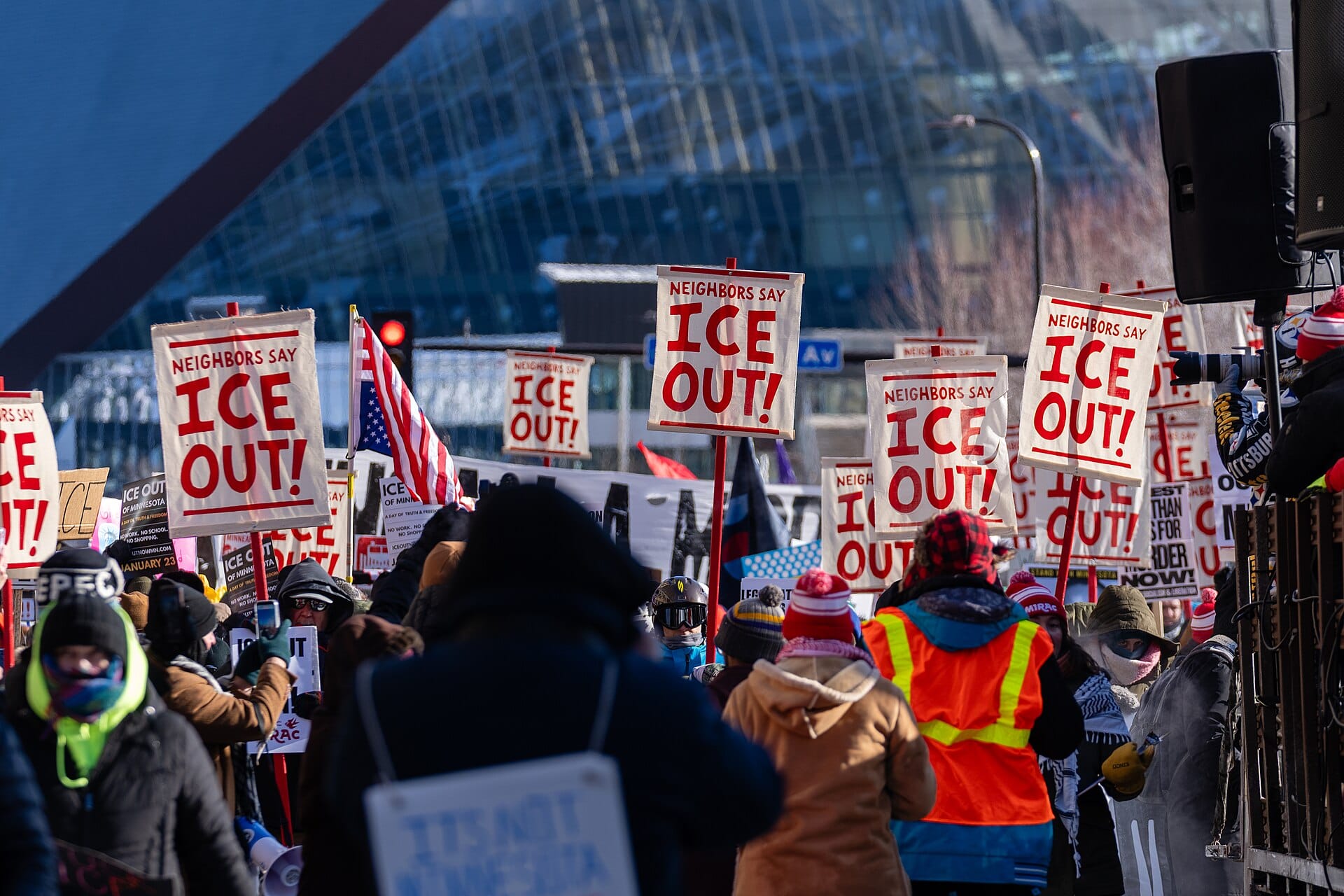
Yes, a very recent one actually, and one that's still politically relevant: if we look at the ICE Out movement in the Twin Cities in the US, it meets all the classic characteristics of a social movement.
It doesn't have formal hierarchies or leadership. People are organized in dense relational networks that are mainly based on previously existing ties of friendship, family, neighborhood, co-workers. And from all that I've read about it, people are extremely supportive because of these pre-existing ties. It's people organizing to protect their neighbors with their neighbors, to protect their family together with their neighbors. And this has been creating a very strong support.
For example, a lot of migrants currently cannot go out to work and there are people covering their shifts. There are people who provide free lunches to school children. There are people that shuttle children from migrant parents to school so the parents don't have to leave the house. There are people on every block that have whistles that they can use to alert each other in case ICE enters the city. And it is basically marginalized people being targeted by one of the most powerful law enforcement agencies in the world with violence, intimidation, and a lot of human resources being sent into a city in extremely adverse weather conditions.
And somehow, through the support for each other, and through this feeling of unity and solidarity that is generated, people have supported each other through this and essentially enforced that ICE is not in the Twin Cities anymore. So I think this is a recent and politically relevant example of how social support plays a huge role. Because if all of these people had just relied on their individual networks, I don't think it would have worked.
I think that's a good note to end on. Thank you!
Footnotes
[1]: For those of you interested in learning more about these scholars, Timo recommends two books: The Politics of Nonviolent Action, Part 1: Power and Struggle by Gene Sharp and Social Movements, 1768-2004 by Charles Tilly
Thanks for reading
There are many ways you can help:
- Subscribe, if you haven't already!
- Share this post on Bluesky, Twitter/X, LinkedIn, Facebook, or wherever else you hang out online.
- Become a patron for the price of 1 cappuccino per month
- Drop a few bucks in my tip jar
- Send recommendations for research to feature in my monthly paper roundups to elise@reviewertoo.com with the subject line "Paper Roundup Recommendation"
- Tell me about your research for a Q&A post (email enquiries to elise@reviewertoo.com)
- Follow me on Bluesky
- Spread the word!