Does biology play dice?
Some thoughts on nature, nurture, and chance in development

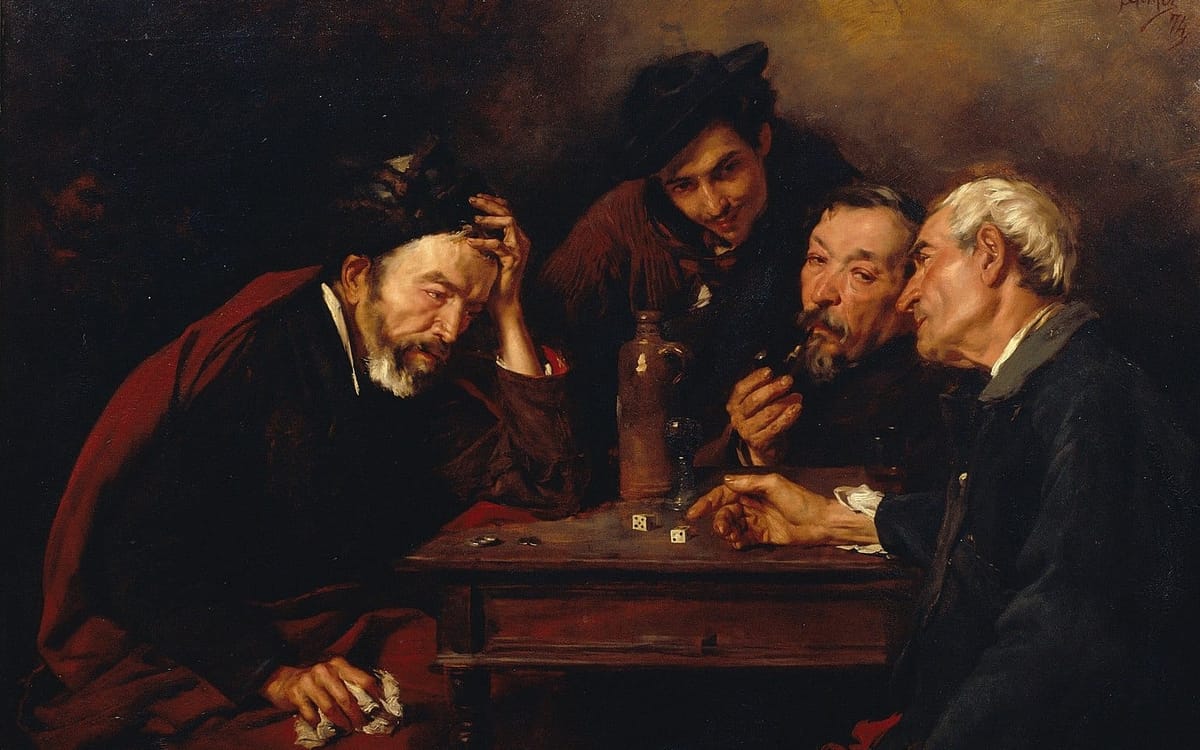
There’s something deeply unsatisfying about randomness.
Humans, like other animals, are attuned to cause-and-effect. A lot of the work of being a baby is building a causal model of the world: If I drop this fork, then what happens? We seem to come pre-loaded with a toolkit for statistical inference. There’s research, for instance by Alison Gopnik, suggesting that children playing with unfamiliar devices are good little scientists: they adjust their expectations about how the device will behave given the results of their “experiments” in roughly the way that Bayes’ Rule, the holy scripture of probabilistic reasoning, would demand.[1] A certain strain of cognitive science — Karl Friston’s free energy principle and its many spinoffs — even asserts causal modeling as the one true purpose of the brain (and maybe life itself).
Our ability to not just experience but also explain the things that happen to us is what makes our species so good at navigating and exploiting the world. And as humans, this knowledge is not confined to the mire of the animal implicit. We have language. Armed with words, the animal causal modeling instinct takes on new life as the human storytelling instinct.
 Elise Cutts
Every human culture has its fables and folktales. But story in a more general sense — a narrative structure of cause-effect links running from beginning to end — seems so fundamental to human cognition that it’s hard to imagine thinking without it. The driest mathematical proof follows a linear progression from beginning to end, each step enabled by the ones before. Making plans and predictions rests on our ability to concoct mental fictions. And story might even underpin memory. Between 4 and 7 years old, kids get much better at both remembering things and telling stories. And today, researchers published a study of 77 kids in this age group showing that youngsters who could tell more cohesive stories about silent cartoons were able to recall more factual information about the videos one week later. To quote the study authors:
Young children’s memory may be limited in part by their lack of the semantic knowledge necessary to construct narratives, and/or by their impoverished understanding of narrative structure in general.
I bring all this up because I believe that the same attention to cause-effect relationships that makes us such avid storytellers (and such clever apes) has also left us with an instinctive distaste for random chance that’s problematic in science and science communication.
Take the genome.
Often, especially in popular writing but also in science, the genome is described as a blueprint. A blueprint isn’t a building, but every part of a blueprint corresponds 1:1 to the completed structure. Drawings of windows correspond to windows, drawings of beams correspond to beams. Likewise, the genetic blueprint isn’t an organism, but every part of it corresponds exactly to some phenotype or trait of the organism it codes for. One gene might mean you end up with green eyes. Another could condemn you to a life of picking cilantro out of your food because it tastes like soap to you.
Except, that’s not how it works at all. Crack open the genome and nowhere will you find anything like an eye or a hand or a distaste for cilantro. Genes do not correspond 1:1 to physical or behavioral traits. Even in the case of single-gene disorders in which one mutation clearly causes a disease — say, in the case of the mutations of the CFTR gene that cause cystic fibrosis — the relation between genotype and phenotype is not the isomorphic kinship of blueprint and building. The word “hell” is enough to get a movie labeled PG-13 in the United States. But there’s nothing about the sequence of letters h-e-l-l that “codes for” a PG-13 rating. Likewise, a mutated CFTR gene produces a protein that causes cystic fibrosis in the context of a living human body, but it does not “code for” cystic fibrosis.
But there’s a deeper problem with the genome as blueprint metaphor: the blueprint does not accommodate chance.
It’s no deep secret that development — the way an organism grows and changes from birth to death — is noisy. The same genome run twice through development will not yield the same result. Even identical twins are not truly identical. And clones are just knock-off identical twins. Yet even scientists will still often boil down development to genetic nature and environmental nurture, with little room for chance. I spoke yesterday with Kevin Mitchell, a neurogeneticist at Trinity College Dublin who’s something of an evangelist of Fortuna in biology, and he put it like this:
As a developmental biologist, we deal with this all the time. We see this variability all the time. And yet many geneticists seem to be just ignoring it. There’s some sort of antipathy toward the idea — like it is an affront to their scientific sensibilities that something could be kind of ‘uncaused.’
On the face of it, science is very chance-friendly. In experimental science, random chance is the null hypothesis — the default explanation, the story to beat. The statistical tests that you'll find trailing scientific results like pilot fish — p<0.05, five sigma and co. — report the odds of getting a result at random. They're fluke scores. And you're only allowed to say you have evidence for something once its fluke score gets low enough.
But that’s what science does, not what science means. Fundamentally, laws of nature don’t make room for chance at all. If you think that the universe begins and ends with matter, energy, and the four dimensions of spacetime and accept that everything in the universe is governed by physical law, where’s the room for fortune? Everything that ever has or will happen is completely and fully determined by the initial conditions of the universe and a set of dynamical physical laws. You can roll dice, sure. But the outcome is predetermined.
Mitchell, together with physicist colleagues, has argued that the universe is not actually deterministic in this way — that there is true random chance that arises from aspects of quantum mechanics that scientists still argue about how best to interpret. But the deterministic argument against biological randomness is a red herring. You do not need to throw out determinism to accept the role of chance in biology. Even in a perfectly classical billiard ball universe in which nothing is fundamentally random, biology still plays dice.
Because what does randomness mean, really? One of the early, enduring results of dynamical systems science was to show that there are limits to weather prediction. Weather is chaotic, meaning that tiny differences in its current state compound into enormous differences in its future state. That means our ability to predict the future is fundamentally limited by our ability to measure the present. So while chaotic systems are entirely deterministic in theory— that is, if you could somehow perfectly reset and “run” them again, the outcome would be identical — they are unpredictable in practice.
We are not Laplace’s demon. Our knowledge of the present will never be perfect, and therefore there are things we will never be able to predict. These things, I’d say, it makes sense to call “random” — even though they are perfectly deterministic dominoes in the long chain of cause and effect stretching back to the beginning of time.
If we, with our telescopes and microscopes and computers, are not Laplace’s demon, then the evolved mess of biology definitely isn’t. There are things that a genome simply cannot sense, anticipate, or respond to. The ceaseless thermal jiggling of molecules is perhaps the most straightforward example. Just as we can predict the climate 100 years from now but not the weather 100 days from now, a genome can “plan for” an average temperature during development,[2] but not the particular jiggle of a particular molecule in a part of a particular cell on exactly day 100 after sperm meets egg.
You might say that chance in development is everything that can influence traits, but that an organism can't understand (in whatever way it "understands" anything) in terms of cause-and-effect. Chance stands just beyond life’s causal model, pushing on it from the outside.
I suspect that the myth of a deterministic genetic blueprint endures despite its obvious flaws because it is just such a satisfying story.[3] The more important something is, the harder time we generally have accepting that it could be subject to the whims of fate — the more we need a story, an explanation, for the things that go wrong. And what could be more important than our bodies — our health? So the folk dialectic of biological development presents a simple story of nature versus nurture. Nurture is everything that isn't nature. Nature is the genome. Everything we are either emerges from our experiences, culture, and environment or is "written in our DNA” and therefore predetermined and immutable. There is no room made for chance, and that’s reassuring.
We might not like what’s written in our DNA or what happened to us during our development. But at least it’s knowable.
This reminds me of something that Natalie Wynn points out in her deep-dive video essay on conspiracy theories: some people would rather believe that there's a satanic cabal controlling the world than accept that, sometimes, bad things happen for no good reason. There's something darkly reassuring about thinking the world is run by the organized forces of evil. There’s no reasoning with chance, but you can learn to interpret the signs and motives of the occult world order. Your fate might not be entirely in your own hands, but it's at least in someone’s.
The conspicuous absence of chance in “wellness” discourse often manifests as a subtle echo of conspiracist thinking. This happens when we see a fit marathon runner inexplicably succumb to cancer at 26 and wonder what wellness sin she must have committed to deserve her fate. Cigarettes? French fries? Unspeakable acts of depravity? If it isn't her fault, someone else must be to blame: the factory dumping forever chemicals into the nearby river, the fat-cat capitalists stuffing foods with artificial fillers for a few extra pennies per sale, or the politicians who refuse to do something, anything about microplastics. It certainly couldn't have been bad luck.
Bad biology is increasingly a political issue. The strange alliance of organic hippie moms and supplement-shilling podcast bros that came together under RFK Jr.'s "Make America Healthy Again" banner makes that abundantly clear. Across the political spectrum, people are clearly itching for a witch hunt approach to health and disease, and especially developmental disorders like autism. If there's something wrong, someone or something must be to blame.
At some level, it's perfectly fine to care about — and study — the environmental and genetic factors at play in development, including in autism. Personally, I think it’s very important. It’s hard to understate the significance of protecting kids from lead and fetal alcohol exposure or screening for BRCA1 in people at high risk for breast cancer. But the blame game is not about science. It discards objective complexity for the reassuring moral simplicity of bedtime stories, complete with evil witches. RFK Jr. and co. have revived the refrigerator mother hypothesis to blame women for autism. This time, it's not withholding emotional warmth that's the problem. It's taking Tylenol and failing to provide your child with a healthy diet of organic grass-fed beef liver and cane sugar Coca Cola. Pushed just a little further, the biological blame game metamorphoses into something deeply ugly: accept that bodies you don’t like are the result of choices you don’t like, and it becomes easier to punish them. To be sick, disabled, or different becomes an outward sign of inner moral corruption — if not one’s own, then someone else’s. Probably mom's.
So while I love a good story, I'm becoming an even bigger fan of chance. I think we'd all be a little less paranoid, less prejudiced, and maybe even a little less evil if we cultivated the habit of starting with "wait, this might have just been a coincidence" whenever something happens that we don't like. Biology would be a good place to start.
Footnotes
[1]: Gopnik discusses her work on how children learn and the degree to which they're "good little Bayesians" on episode 308 of Sean Carroll's Mindscape podcast.
[2]: Sea turtles are a dramatic example. They lack sex chromosomes, so the sex of a baby turtle is determined not by genetics but by the temperature of the sand it incubates in.
[3]: Mitchell and colleagues recently proposed an alternative metaphore of the genome as a generative model, like Midjourney. If you liked this post, check out the preprint, which gets into far more detail on many of the points discussed here than I could here!
Thanks for reading
There are many ways you can help:
- Subscribe, if you haven't already!
- Share this post on Bluesky, Twitter/X, LinkedIn, Facebook, or wherever else you hang out online.
- Become a patron for the price of 1 cappuccino per month
- Drop a few bucks in my tip jar
- Send recommendations for research to feature in my monthly paper roundups to elise@reviewertoo.com with the subject line "Paper Roundup Recommendation"
- Tell me about your research for a Q&A post (email enquiries to elise@reviewertoo.com)
- Follow me on Bluesky
- Spread the word!