Is the NSF slashing research to fund a tech initiative?
Also: SciAm sold, two Max Planck papers retracted, a big study links AI to skill atrophy in schoolkids, and more from last week

Comments and feedback are greatly appreciated right now. So drop a comment below or get in touch at elise@reviewertoo.com. And if you're new here, subscribe for free to unlock the full newsletter.
Science published a shocking scoop last week: Insiders at the U.S. National Science Foundation — the major U.S. funder of basic research — told reporter Jeffrey Mervis that the agency is cutting funding for science programs by 20-30% this year. Some fields will be hit harder than others: Mervis' sources said geosciences could be cut by 60% and biology by 75%. Program managers were told to keep quiet about the cuts rather than tell scientists what was happening.
The hush-hush budget cuts could explain why so few NSF grants have been awarded this year. Even though the enacted 2026 NSF budget is just 3% less than in 2025, only one eighth of the grants awarded in fiscal year 2025 had been awarded by June 15 this year (more than 60% through the fiscal year). That's according to funding watchdog Grant Witness. And 2025 was already a bad year; the last time so few grants were awarded was 1985.
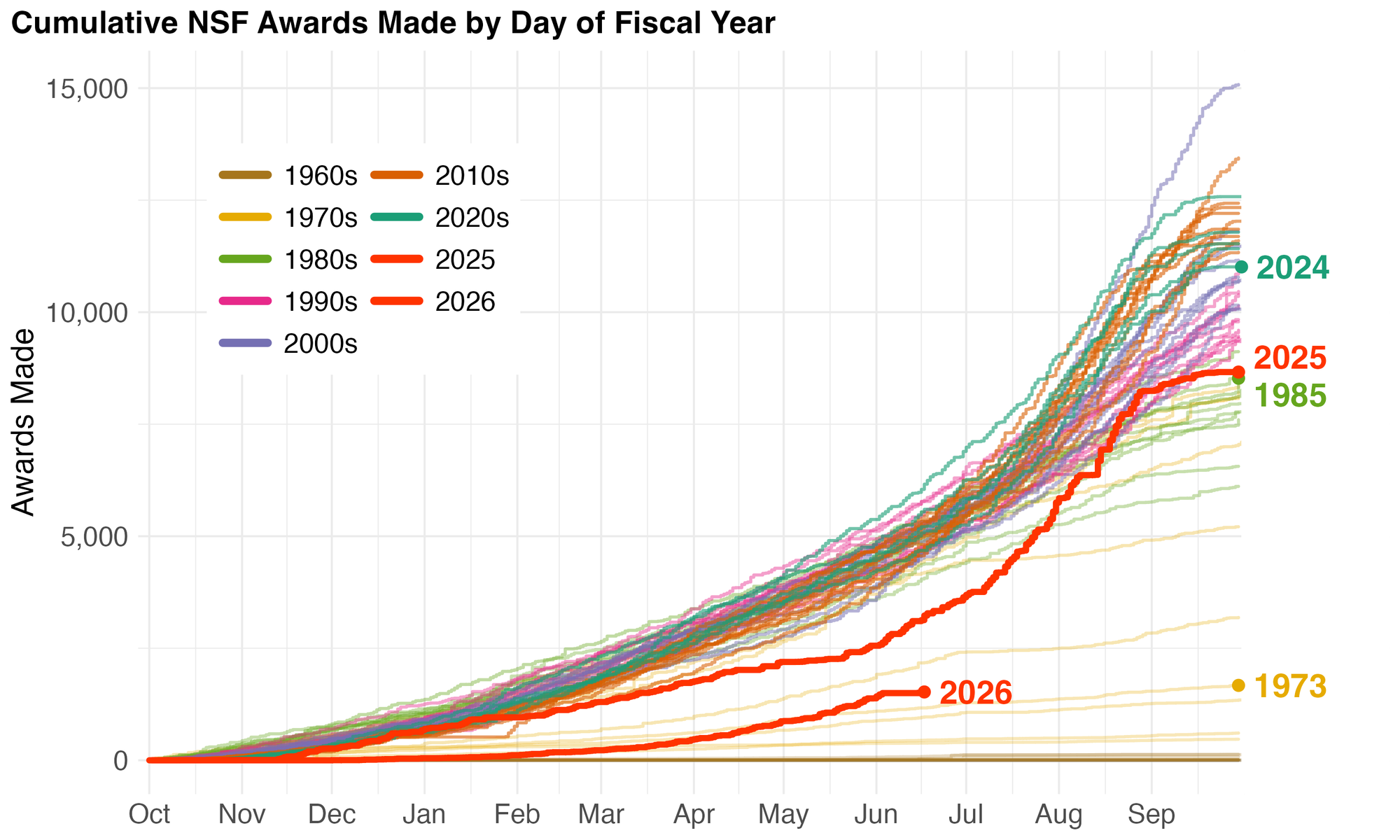
The cuts have not been publicly announced or explained. Mervis' sources say they suspect the funding is being held to fund the recently announced X-Labs initiative: a plan to award up to $1.5 billion over 10 years to "a new generation of transformative independent research institutions ... outside of traditional institutions." The funding is pretty transparently intended for industry, not academic research.
NSF X-Labs will move beyond traditional research outputs (e.g., publications and datasets), with sufficient resources, financial runway and independence to transition critical technology from early concepts or prototypes to commercially viable platforms ready for private investment to scale and deploy. (NSF News, May 14)
In principle, I think a more flexible and diverse ecosystem of research funding for more diverse and experimental kinds of institutions and teams would probably be a good thing. So, in principle, I think something like X-Labs would probably be good if it didn't cut into basic research funding. But it's clearly a political choice to fund X-Labs by slashing the already — in the scheme of the U.S. federal budget — quite small allotment for basic academic science. The first 6 days of the War in Iran cost $11.3 billion, enough to fund the X-Labs initiative more than 7 times over and 57% more than the entire research budget of the NSF.[1] In the current political context, with an administration gunning to cut NSF funding in half in 2027, a Vice President who's openly argued that "professors are the enemy," and an administration that's repeatedly used federal research dollars to bully universities, it's hard to see X-Labs as anything other than an open move to grab funding from academics and hand it to political allies in tech.
(Also, one really must wonder: is it a coincidence that Elon Musk's favorite letter ended up in the name? The plan was originally called "Tech Labs.")
These cuts have not yet been publicly announced, so I can't confirm them or dig into any data; Mervis' article is based on leaked internal memos and comments from anonymous sources inside the NSF. But 20-30% of the 2026 NSF $7.2 billion research budget would be $1.44-2.16 billion. That's far more than the ~$150 million needed to fund X-Labs for 1 year. The numbers line up better if you assume the X-Labs program will be given several years of funding up-front. The National Institutes of Health awarded more grants this way last year and wants Congress to allow more advance funding, so there is precedent. But it remains to be seen if X-Labs really is the explanation for the NSF cuts.
As we wait for the dust to settle on all this, I think it's important to remember that every missing grant should have gone to someone. A real, specific person did not get that money when they should have. And especially for young scientists, losing out on a single grant at the wrong moment can very well mean the end of a career. When U.S. science gets out of this mess, funding will hopefully be restored. But it won't bring back the people forced to leave science in the meantime.
My friend's NSF CAREER received the highest possible score (Excellent, Excellent, Excellent: High Priority) and it was rejected today. This would have been my friend's first extramural award, 5 years after starting their lab, exactly when grant $ is make or break for an Assistant Professor's career.
— Emily Bruce (@brucelab.bsky.social) June 22, 2026 at 7:11 PM
[image or embed]
[1]: 2026 funding for "research and related activities" was $7.2 billion, its 2025 level. Had the Trump White House gotten its way, the research budget would have been slashed to $3.3 billion in 2026.
Citation Needed
Last week in links and notes.
Scientific American will be sold in a "union-busting" move. Staff say 15 to be fired, salaries slashed
Springer Nature announced that it is going to sell Scientific American to LabX Media Group, which owns Discover, IFLScience, and The Scientist. It is also selling Spektrum der Wissenschaft, one of Germany's top science magazines, to a German publishing group. Dan Vergano, former senior editor for U.S. science policy at Scientific American, said in a Bluesky post that the magazine fired him and other staff just 3 days before the National Labor Relations Board was due to count votes on unionizing the staff. The cuts include 60% of the union organizing committee. A statement from Scientific American staff in the Writers Guild of America East implies that the decision is not just union-busting, but might have something to do with political pressure from the Trump administration:
We should call this action what it is – blatant union-busting. But there’s worse: we also have reason to believe that the sale was motivated by fear within Springer Nature that our attempts to doggedly report on the crisis facing science in America today would lead to repercussions from the Trump administration. On multiple occasions the company has sought to quash or tone down political or sensitive stories that were journalistically sound.
A rally is planned for Tuesday, June 30 at 17:00 U.S. Eastern Time outside the Springer Nature offices in New York City.

This is not a paywall!
Subscribe for free to keep reading.