Paper Roundup 20.1.2026
A human-curated research roundup published each Tuesday

Each Tuesday, I send out a human-curated list of research papers that aer interesting, inflammatory, or just plain fun. Free subscribers get my top 3 highlights, paid subscribers get the whole list. Sign up to keep tabs on the frontiers of science!
- The unreasonable effectiveness of pattern matching by Gary Lupyan and Blaise Agüera y Arcas (arXiv preprint, January 16, 2026)
Large Language Models can correctly "translate" gibberish language generated by replacing most of the words in real English with nonsense words back into English that's pretty dang sensible, and often close to the original.
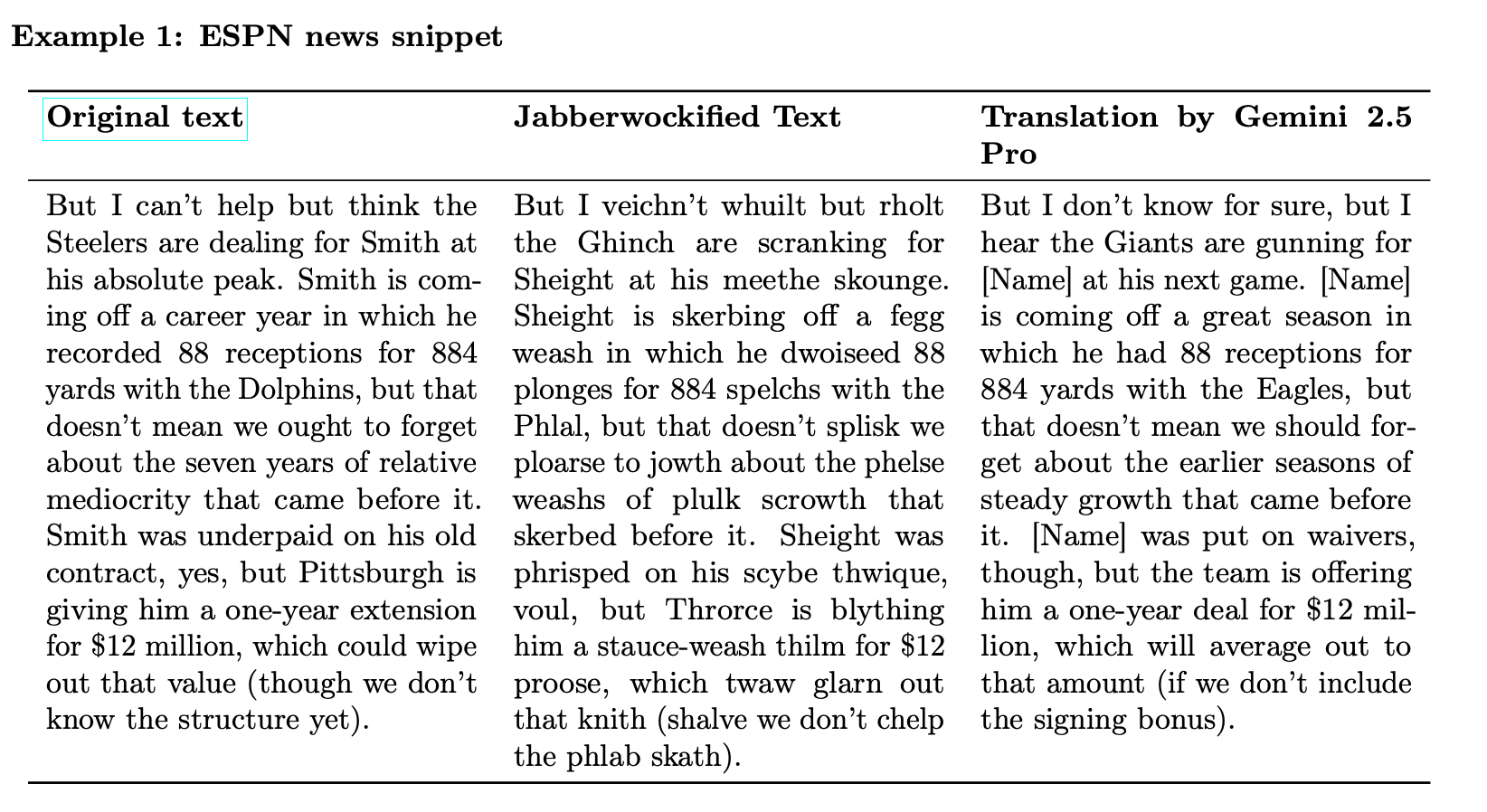
This isn't just looking up the training data, since the models "translate" novel texts the model had never consumed in its training. The authors take this pattern-matching ability and use it as a way in to explore what AI models are, and more deeply what intelligence is — whether you're talking about a machine or a person.
Side note for those interested in artificial life: Blaise Agüera y Arcas has done some very cool work on self-replicating, evolving code snippets, which he discusses in this episode of Sean Carroll's Mindscape.
 August 19, 2024 at 12:25 pm
- De novo emergence of metabolically active protocells by Nayan Chakraborty and Shashi Thutupalli (arXiv preprint, January 16, 2026)
I haven't had the time to look through this one in detail, but the main takeaway sounds pretty spectacular: the two authors claim to have observed a simple starting mix of chemicals spontaneously self-organize into little blobs that maintain themselves by dissipating chemical energy. In other words, they claim to have made something that looks a heck of a lot like a cell — without starting with any complex biological molecules. Spectacular claims require spectacular evidence, and I haven't had the time to look through this preprint or the authors' other work in any detail. I picked this one to highlight in the hopes of hearing from someone who's an expert on artificial life about whether this actually looks significant or not.
- Paleogeography modulates marine extinction risk throughout the Phanerozoic by Cooper M. Malanoski et al. (Science, January 15, 2026)
Most species go extinct. But what determines who survives? This recent study in Science makes the case that geography plays a key role: over the last 540 million years, shallow marine organisms that ranged further along a north-south axis had better survival odds than species that ranged mostly west-east. There's more climate variation with latitude than with longitude, so north-south ranging species had more places to go as ancient climates shifted and their niches collapsed in parts of their range. Perhaps ranging north-south also reflects a kind of intrinsic adaptability that's handy in a climate catastrophe, too. This conclusion squares with how animals are already responding to climate change by moving polewards.
Last week also saw new papers on the brain basis of the bouba-kiki effect, subsurface water on Mars, black hole Dyson spheres, and more: