About "to" and "around" the Moon
Technically correct is not, in fact, the best kind of correct in scicomm

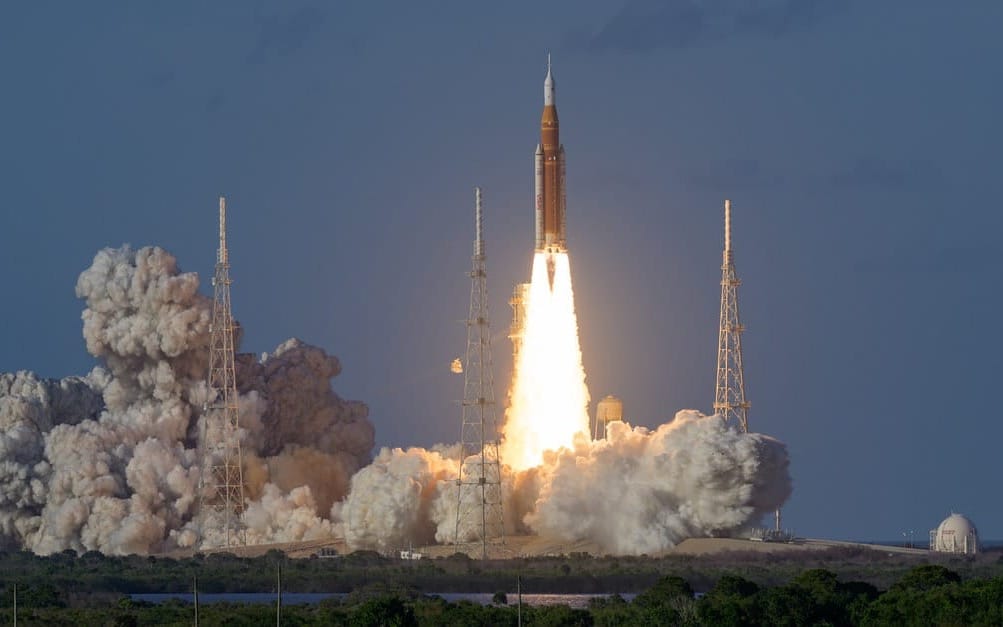
Is it fair to say the Artemis astronauts are going to the moon?
Amid all the excitement over the launch, this question is what Bluesky has decided to concern itself with. And it has uncovered what is, in my view, a revealing pattern: Scientists and space nerds mostly favored saying Artemis II is going "to the Moon." Other folks — including science journalists — preferred alternatives like "around the Moon" and "lunar flyby."
Why might that be? (Scientists forget that not everyone is a nerd)
Who's right? (Both sides, but one is only technically right and that side is actually wrong)
Isn't this a stupid debate? (No)
We'll get to that. But first let's take a look at the arguments for both sides, because Bluesky drama is fun.
Team "to" the Moon
The to vs around debate began when Katie Mack, an astrophysicist and one of the most-followed science accounts on Bluesky, raised the question of "to" vs "around" and declared herself for team "to:"
Can we have a ruling on whether #Artemis II is (a) "a mission to the Moon" or do we have to say (b) "a lunar flyby" just because they're not landing? I say (a) is okay: they're definitely going to the Moon! And past it! They're just not touching down.
— Katie Mack (@astrokatie.com) April 2, 2026 at 1:00 AM
Pulling together points from the many comments and reposts, here are the key arguments for Team "to:"
- They're going to the Moon, they're just not touching down.
- If they're not going to the Moon, where are they going? There's no other location you can name that makes sense.
I feel like they're going to the moon, they're just no landing. I've got a flight from Auckland to Vancouver in a couple weeks, where I am changing planes to my further actual destination, doesn't mean I'm not going to Vancouver for this part of the trip regardless of actually being in Vancouver.
— Dr Sarah Hendrica Bickerton 🏳️🌈 (@sarahhbickerton.bsky.social) April 2, 2026 at 1:03 AM
definitely A! i mean, if they aren't going to the moon where else are they going?!
— Prof Christina Pagel (@chrischirp.bsky.social) April 2, 2026 at 1:03 AM
- Robotic missions to other planets and planetary objects are straightforwardly called missions "to" those worlds, even if no rover or probe touches down: Juno is a mission to Jupiter, Cassini was a mission to Saturn, New Horizons was a mission to Pluto, etc. Why should this be any different for manned missions?
It's a mission to the Moon. Juno is a mission Jupiter and it never landed. I could throw out another 2 to 3 dozen examples. Mission to the Moon, definitely. Very exciting!
— Alejandro Soto (@soto.space) April 2, 2026 at 1:03 AM
While I think NASA officially calls it something like option B, I would say option A is more consistent with historic planetary missions. If a mission orbits a body, it's a mission to that body (Galileo, Cassini, Juno). A flyby literally just flies by (e.g. New Horizons or the Voyagers).
— Mark Panning (@markpanning.seismology.space) April 2, 2026 at 1:23 AM
[image or embed]
- They're going within the Moon's sphere of gravitational influence — the imaginary region around the Moon within which its gravity dominates over the gravity of other bodies like the Earth and Sun — and that's what counts.
- The same as above, except using the technical jargon Hill Sphere instead of saying gravitational sphere of influence.
- A "mission to the Moon" sounds bigger and more impressive
"A mission around the Moon" sounds both bigger and more accurate to me
— Randy Tayler (@randytayler.com) April 2, 2026 at 1:03 AM
- Space is hard so we should use the more impressive-sounding term, and us non-astronauts maybe don't even have a right to an opinion on this.
Definitely (a). Because space is hard. They will be travelling 384,400 km, which is: - 920 × the height of the ISS - 1,100 × typical Low Earth Orbit altitude - 1,000 Sydney to Melbourne flights Just because they're not landing doesn't mean they didn't face all the problems of flying to the Moon!
— Sean M. Elliott (@seanmelliott.bsky.social) April 2, 2026 at 1:17 AM
[image or embed]
The only people who are allowed to make this distinction are the remaining guys who landed on the Moon. For the rest of us, they are indeed going to the Moon. #Artemis
— Martin Hajovsky (@martinhajovsky.bsky.social) April 2, 2026 at 1:19 AM
[image or embed]
- They're going to see the dark side of the moon and very few astronauts have, so they are going "to the moon."
By the authority vested in me as a space kid, if you are one of the 24 humans who have ever looked at the other side of the moon, you have been to the moon.
— Jason Darr (@jasondtx.bsky.social) April 2, 2026 at 1:25 AM
[image or embed]
- The mission will put the Moon entirely between the astronauts and the Earth, isolating them from radio communications, so it's a "mission to the Moon"
I’ll admit that this is more vibes than logic, but I feel that since the mission will put the Moon entirely between them and Earth, blocking all view and radio communications with Earth, leaving them the only four humans in the whole universe that they can detect, it’s a “mission to the Moon.”
— Emily Lakdawalla 🏳️⚧️ Uranus Expert (@elakdawalla.bsky.social) April 2, 2026 at 1:39 AM
[image or embed]
Team "around" the Moon
In contrast, the opposing side of the great Artemis II preposition debate basically had just one argument:
- Saying you're going "to the Moon" is misleading, because people who hear that will think that astronauts are literally landing on the moon.
The popular version of this point involves colorful analogies to saying you're going somewhere and then just driving or flying past it:
Someone with children should try “Hey kids! We’re going to the beach!”, and pull that move to see how it goes.
— Hector Rodriguez (@rocketcheddar.bsky.social) April 2, 2026 at 1:04 AM
If I tell my kid “we’re going to Disneyland!” and then I circle Orlando and come home, they will never forgive me, and I won’t be able to blame them. This is a lunar flyby.
— Be Jay, Do Crimes. (@templinjay.bsky.social) April 2, 2026 at 2:14 AM
b) - you don't say you went to Bruger King when you drive by Burger King
— Fil K (@nashfil.bsky.social) April 2, 2026 at 4:10 AM
B. I’m not on a “mission to Iceland” if my Airbus 340 flies over it on the way to Europe
— Shelley (@dialectics68.bsky.social) April 2, 2026 at 3:25 PM
By far the most exhaustive argument against saying "to the Moon" was laid out by freelance science journalist — and fact-checker, that's relevant — Erin Biba. I can't embed Erin's post because it is only visible to logged-in viewers. But here's a screenshot to get you started and a link to a thread explaining the position for Bluesky folk with accounts.
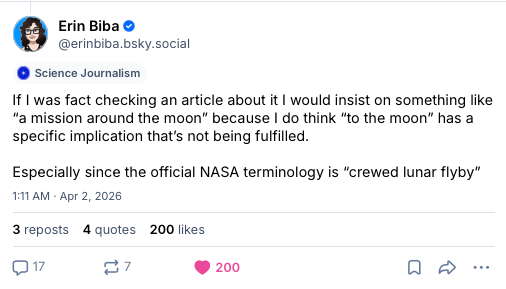
This, to me is the most important point:
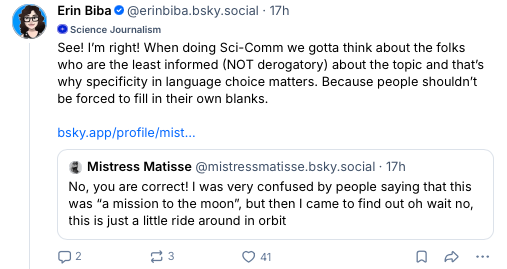
(There was also some griping about not making Trump's NASA look good. Bad argument, folks!)

Look. You and I both know that if I were a barista, you'd 100% be leaving a tip right now. The social pressure to drop a coin in that jar would just be overwhelming. But you're presumably reading this thing alone on a universe-rectangle, so I can't rely on my mere presence to remind you to be nice.
If you made it this far I assume you're enjoying the article. So maybe drop a coin in my digital tip jar. It's just €2 per month (€0.25 per post!) — a cheap and fully automated weekly warm fuzzy feeling for the digital age.
Being technically correct is not a high enough standard for science communication
Both sides are right, but only one is technically right.
And technically right is the worst kind of right for science communication.
If you are sharing science with a non-technical audience, your job is not only to say things that are true, but to make sure the people listening to you understand what you said. We all understand that facts, presented the wrong way, can be misleading — a good example is how racists cite crime or educational achievement or health or IQ statistics for various minority communities without adding crucial context explaining why the statistics look the way they do.
Good communication means accounting not only for the literal meaning of your words, but how those words will be received by others. It means heading off misconceptions before they can arise. And yes, I'm sorry, but "to the Moon" is really misleading for folks who are not space scientists or space enthusiasts who read astronomy blogs.
Let's talk about why:
This is not a paywall!
Subscribe for free to keep reading.